


Toronto has changed its rules for cafés, corner shops and small businesses in residential areas. The three neighbourhood-retail bylaws are now in force, according to the City's current study page. This is more than an old proposal waiting for a vote.
But the permission depends on the address and the kind of business. A shop on a designated major street follows one route. A small store on an eligible interior lot follows another. A business operated from someone's home follows a third.
We support the change. A nearby place to buy bread, a few groceries or a coffee makes daily life easier. The best model is a small business people can reach on foot, with a practical plan for waste, deliveries and access. The weak promise is that changing zoning will automatically create cheap bakeries on every street. It won't.
The main deal-breaker for an operator is the actual property's permission. Don't sign a lease, buy an oven or plan a patio from a headline saying Toronto has legalised corner stores everywhere.
Checked October 10, 2026. This guide explains the current framework and its practical limits. The old October 30, 2025 committee deadline and consultation events have passed.
What has Toronto actually approved?

City Council adopted the neighbourhood-retail item in November 2025. The three bylaws were enacted on December 17, 2025. The current City study page says they are now in force.
| Route | Bylaw | What it covers | The important limit |
|---|---|---|---|
| Major streets | 1509-2025 | Small commercial uses on eligible residentially zoned lots abutting designated major streets | Some road segments are excluded. Size, entrance and use conditions apply. |
| Neighbourhood interiors | 1507-2025 | Small retail stores on certain eligible lots in the area shown by the bylaw | It is a defined Toronto and East York area, not every residential street in the city. |
| Home occupations | 1508-2025 | Businesses operated from the operator's principal residence, with updated space, staff and client rules | A home business is not automatically a public café or retail shop. |
Some older sections of the study page still describe proposals and a 2025 survey. Read the current status at the top and the enacted bylaws when deciding what is allowed. The older consultation wording does not overturn the later decision.
An existing café may also have permissions from its zoning, an earlier approval or a different part of the bylaw. A shopfront that looks as though it used to be a store is not proof that a new business can open there today.
Major streets allow a wider range of small businesses

Bylaw 1509-2025 adds conditional permissions for uses such as shops, eating establishments, offices, education, personal services, studios and wellness services on eligible residentially zoned major-street lots.
“Major street” is a mapped planning term. It does not simply mean a road that feels busy to you. The lot's front or side boundary needs the required relationship to the designated street.
An individual establishment is limited to 150 square metres under this framework. In a non-apartment building, the combined commercial area is also limited to 150 square metres. Apartment buildings have a different combined limit of 400 square metres and a first-storey percentage cap.
Most of these uses belong on the first storey. Specified office, education and health-related uses can have second-storey permissions with further conditions. Waste storage, pedestrian entrances and other standards still matter. This is a small-business framework, not an unlimited commercial conversion.
A busy road can still have an excluded stretch
The bylaw lists 33 excluded road segments. Examples include Sheppard Avenue West between Bathurst and Jane, Wilson Avenue between Bathurst and Jane, and specified stretches of Morningside Avenue, Warden Avenue and Guildwood Parkway.
Do not assume that all of each named road is excluded, or that every other lot is eligible. Check the actual segment, zone and property. This is the first thing we would resolve before paying for a business plan based on one address.
Can a major-street café have a patio?
There are conditional patio permissions, but the zone-specific rules need checking. For example, the new R-zone major-street patio provision has a 10-square-metre limit, location and neighbour-setback conditions, and fencing requirements where it meets residential lots. It does not allow the patio to provide entertainment such as performances, music and dancing.
A patio permission is separate from a claim that every café can put tables on any sidewalk. The property, public right-of-way, licensing and other applicable rules still have to work. Choose a site whose actual permissions fit the business you want to run.
Interior streets have a smaller, more limited route

Bylaw 1507-2025 uses the Toronto and East York Community Council area shown in its Diagram 1. The outlined area is a coverage boundary. It does not make every lot inside suitable for retail.
The eligible relationships include a corner lot abutting a mapped community street, or a qualifying lot beside a park, public school or specified non-residential zone on the same street. Building types and the exact zone also matter.
The store's dedicated interior area cannot exceed 110 square metres. It must not be above the first storey, and it must be the building's only non-residential use under this permission. The rules also address enclosed waste storage and prohibit operating the premises as a distribution warehouse.
The practical idea is a small store near daily activity, not a full commercial strip inserted into every side street. We think that is a useful opening. The geographic limit is still a real weakness for residents elsewhere who want the same nearby services.
Does this let any Scarborough house become a corner shop?
No. A residential interior lot in Port Union cannot rely on the Toronto and East York coverage rule just because Port Union is part of Toronto. The major-street route or other existing permissions can be a separate question for a particular property.
Read the full bylaw and community-street diagrams, then check the actual lot. A Google Maps café pin does not show zoning permission or a legal coverage boundary.
Can the store include a café or bakery?
The interior-store permission can include an ancillary eating or takeout establishment, with food prepared off-site. Ancillary means it is a supporting part of the store rather than a separate standalone business under this permission.
That gives the coffee-and-groceries model a route. It does not grant permission for a full working bakery kitchen or any restaurant menu you choose. If your plan involves baking, cooking, preparation equipment or a different use, have the City classify the actual operation before buying equipment.
Do not confuse the allowance for a small outdoor goods display with permission for a seated patio. A patio may need a separate approval or another permission that applies to the site. One existing café's outdoor chairs do not settle the rules for the house next door.
Home businesses get more room to work, with important exceptions

A home occupation is a business tied to the operator's principal residence. The updated definition can include an ancillary building or structure, such as a qualifying detached outbuilding. It is not a way to move out and turn the whole home into an unrelated commercial premises.
The general rule now allows two employees in addition to the operator. The area limit is the smaller of 25% of the exclusive interior area or 100 square metres. The calculation includes eligible ancillary space the dwelling exclusively occupies.
An office, education use, artist studio, service shop or custom workshop can fall within the client-attendance exceptions. That is useful for some appointment-based and small service businesses. The use still has to match the actual bylaw definition and conditions.
Which service ideas fit, and which need a closer check?
Tax-preparation or planning work can raise an office-use question. Tutoring raises an education-use question. Repair work, creative production and custom work can raise different categories. Don't treat a general list of business ideas as an approved list for one property.
Music and dance instruction have their own location rule: a detached house or detached ancillary building. Personal services such as tailoring, dressmaking, hairdressing and barbering have specific exceptions. Some of those permissions came from the 2022 changes, rather than being invented in 2025.
Regulated health professionals also have a separate provision. It retains a one-employee limit, rather than the general two-employee rule, and has further location conditions. A medical or therapy practice needs that specific check.
Professional credentials, food rules, landlord agreements and condo rules are not cancelled by a zoning amendment. A permitted office use does not make someone a qualified legal, immigration or health practitioner.
Is a home occupation the same thing as a retail shop?
No. The current home-occupation rules still restrict direct physical-goods sales from the dwelling unit and retain other limits, including a ban on operating a distribution warehouse. Outdoor activities, services, displays and open storage are also restricted under the home rules.
A small home office and a shop with walk-in customers are different plans. Resolve the use category first. Don't buy a house on the assumption that calling a café a home business makes the retail restrictions disappear.
Three existing places show why the formats matter
These businesses help explain the idea. They are not legal precedents for another address, and we are not claiming that all three opened because of the new bylaws.
Finch Store: the clearest local example of why the change matters

42 Dewson Street. 416-532-7710. Finch Store's own site describes a café and neighbourhood grocer, with coffee, bread and pantry products. It currently lists daily opening from 8 a.m. to 8 p.m. Recheck holiday hours and the stock you need before a special trip.
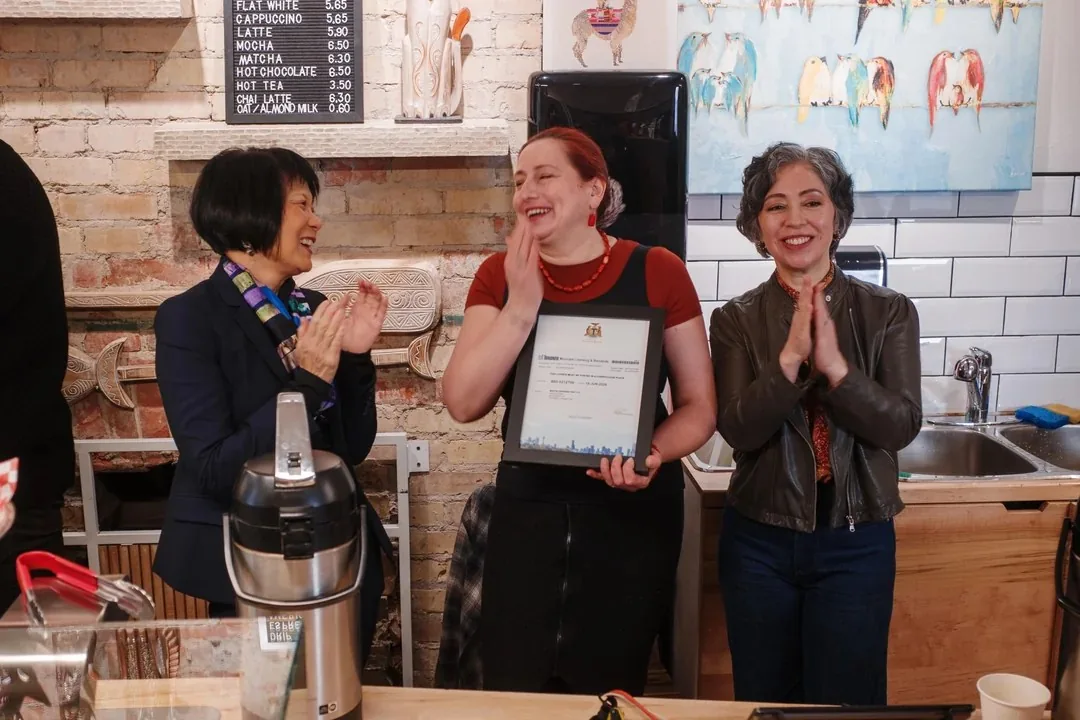
Its March 8, 2026 update says a new licence was granted in late February and delivered by the mayor in early March after the dispute over espresso service. That is a documented outcome from the operator, rather than a prediction that the business is still about to lose its machine.
This is our best example to start with because the issue was practical: a small existing store wanted to serve coffee. You do not need to agree with every claim in a political debate to see why that matters to the people who use it.
Choose it for a local coffee-and-top-up-shopping visit if you are nearby. Compare the current shelf prices before using it for a whole weekly grocery shop. We have not tested the coffee or verified that its prices beat a supermarket.
Tiny's General Store: an interior-neighbourhood example that predates the new rules

80 Barton Avenue, with the side entrance on Euclid Avenue. 416-516-7723. The official store page lists Monday to Friday 8 a.m. to 4:30 p.m., and Saturday and Sunday 9 a.m. to 4:30 p.m. The online shop is still a coming-soon page, not a live grocery inventory.
In a July 2024 interview, owner Chrys Nguyen described creating a café general store for the neighbourhood. That date matters. Tiny's already existed before the 2025 bylaws were enacted.
It is a useful example of a nearby gathering place and a small shop, rather than a reason to assume every residential property can copy its layout or outdoor seating. Choose it as a neighbourhood stop when the address fits your walk. Check the actual stock and prices rather than expecting it to replace a large grocery store.
Martin Espresso Bar: keep the Bloor location separate from Finch

1421 Bloor Street West. 416-531-1421. Martin Espresso Bar is a different location from Finch Store on Dewson. A café on Bloor and a store on a residential side street do not raise identical zoning questions.
The coffee and pastry photographs come from Martin's official website. Use the Bloor address when planning a visit there. Don't take its menu, hours or permissions and silently apply them to the Dewson location.
Choose the location that serves your trip. For understanding the residential-retail story, Finch is the more direct starting point.
The good part, and the limits we should be honest about

Our strongest reason to support nearby shops is simple: some errands should not need a car. Bread, milk, a missing dinner ingredient or a short service appointment is useful within a comfortable walk or roll. That matters to people who don't drive as well as people who would rather leave the car at home.
The City study counts 2,137 neighbourhood retail and service establishments in 1989, and 1,406 in 2019. That is a 34% decline in the category it studied. It is not evidence that Toronto has lost three-quarters of all its corner stores.
The new permissions reduce one barrier. They do not remove the cost of the property, equipment, staffing, repairs and supplies. Nor do they create enough nearby customers for every idea. Buying an expensive house to open a low-traffic shop can still be a poor business decision.
More cafés also do not automatically solve a need for affordable groceries or fresh bread. A neighbourhood can gain several coffee counters and still lack a useful everyday food shop. The question is what people can buy, at what price and how reliably, not just how many espresso machines appear.
Small and independent does not automatically mean cheap
Judge the actual basket. Compare the bread, milk, eggs or produce you would buy with a practical alternative. A convenience premium can be reasonable for a missing item. It is a weak reason to move every weekly purchase to a pricier store.
We have not verified a dependable neighbourhood-wide price comparison or a claim that all small shops buy their goods from Costco. Businesses have different suppliers and costs. Check the place in front of you rather than turning one price complaint into a verdict about all independent grocers.
Noise and access are real questions, not reasons to dismiss the whole idea
A daytime grocery, a coffee counter, a late restaurant and a nightclub are different operations. Traffic, delivery noise and customers outside can affect neighbours in different ways. The useful discussion names the actual problem and a workable limit.
The City says existing noise, waste, property-standard and patio bylaws continue to apply. Enclosed waste storage and the new entrance conditions also form part of the framework. It is wrong to describe the change as removing all control over businesses.
But a ground-floor permission does not prove that every shop has an easy entrance or an accessible washroom. Ask about the full route before a visit, and design it properly before opening. Nearby should also mean usable.
We would support practical small shops and clear operating rules. We would not promise that every proposal is profitable, every neighbour is unaffected or property values will rise because a café opens nearby.
Before opening a business, check the address and the operation

Start with the exact address, zone, street designation, building type and intended use. Add the floor area, customer arrangements, food preparation, staff, delivery plan and any outdoor space. A vague idea such as “small café” leaves too much unanswered.
- Identify which route applies: major street, eligible interior retail or home occupation.
- Read the enacted bylaw and the current zoning information for the property.
- Ask the City to classify the actual activity, including any baking, cooking, repair work or client visits.
- Check the required business licence and whether a zoning review is needed.
- Check building, food-premises, fire, access and other requirements for that plan.
- Confirm the landlord or condo conditions before spending on a fit-out.
The City's takeout or retail-food licence page and eating or drinking establishment page explain different categories. Seating, food and the operation can change the answer. A licence category does not replace zoning permission.
The eating-establishment page has a zoning-review requirement and an exception for certain takeovers of an existing licensed business. Don't assume every new plan needs the same paperwork, or that an existing licence covers a changed operation.
The bylaws do not themselves issue liquor, cannabis or other regulated-product permissions. Those need their own check. A headline about corner shops is not an approval to sell every product or run every kind of entertainment.
For residents, the useful next step is to check the current City study and the exact proposal affecting your street. Describe the service you want, or the practical concern you want addressed. Don't send an old committee deadline as though it is still open.
If you want to keep exploring on foot, our Toronto neighbourhood guide and walking routes beyond downtown offer ways to plan the area. Check the city's public-washroom options when access is part of the outing.
Frequently asked questions
Are Toronto's new neighbourhood-retail rules in force?
The current City study page says Bylaws 1507-2025, 1508-2025 and 1509-2025 are now in force. They were enacted December 17, 2025 after Council's November decision. The old 2025 consultation deadlines are not current invitations. Check the actual property before treating the framework as permission for your business.
Can any residential house in Toronto become a café?
No. The major-street, interior-store and home-occupation routes have different conditions. The interior-store bylaw uses a defined Toronto and East York coverage area and specific eligible lot relationships. The zone, building and actual business use still matter.
Can an interior-street corner store include seating and coffee?
The enacted interior-store provision can include an ancillary eating or takeout establishment, with food prepared off-site. It does not automatically permit a standalone restaurant, full bakery kitchen or patio. Have the City classify the menu, equipment and seating for the particular site. Don't rely on the older takeout-only proposal wording as the final rule.
Can I run a small business from a garage or laneway building?
The home-occupation definition can include an ancillary building or structure tied to the operator's principal residence. The use, area and other conditions still apply. It is not blanket permission for a public store or outdoor business activity. Music and dance instruction have a specific detached-building rule.
How many employees can a Toronto home occupation have?
The general updated rule allows two employees in addition to the operator. Regulated health professionals have a separate provision retaining a one-employee limit. Check the actual use category instead of applying the general number to every practice. Professional qualifications and other rules still apply.
What is the size limit for a home business?
Use the smaller of 25% of the relevant exclusive interior area or 100 square metres. Eligible ancillary space is part of the calculation. The area limit does not settle whether the business use or client visits are permitted. Check those separately.
Did the new rules create Finch Store and Tiny's?
Both businesses existed before the bylaws were enacted. Finch's own March 2026 update describes its later licence outcome after the dispute over espresso service. Tiny's owner described the existing store in a July 2024 interview. Their formats are useful examples, not automatic permissions for another lot.
Will more corner shops make groceries and coffee cheaper?
The zoning change does not guarantee lower prices or a particular business opening. Compare actual products and the full shopping basket. A nearby store can be useful for a small top-up while a larger weekly shop still works better elsewhere. We support more useful choices without promising a price result the evidence has not established.