



Toronto housing co-ops can offer stable homes, a real say in how the building is run and, in some cases, lower monthly costs. They are not a secret shortcut to a cheap apartment. Most established co-ops have no vacancy, subsidized homes can take many years to reach, and market-rate applications are handled one co-op at a time.
Our verdict: apply if you want long-term community and can take part in it. Do not apply only because you heard co-ops are cheap. Start with the Co-operative Housing Federation of Toronto directory, contact suitable co-ops directly for market units, and join the City's centralized system if you qualify for rent-geared-to-income housing.
The best alternative for a person who needs a home soon is a regular rental search. The main deal-breaker is time. A co-op application is a long game, not an emergency housing plan.
The short answer
| Question | Honest answer |
|---|---|
| Is a co-op the same as an apartment rental? | No. Residents are members of a non-profit corporation, not ordinary tenants |
| Is every co-op unit subsidized? | No. Many members pay the full market housing charge |
| Is there one Toronto co-op wait-list? | No for market units. Apply to each co-op. RGI applicants use MyAccesstoHousingTO |
| Does CHFT take applications? | No. Its directory helps you find co-ops, but each co-op runs its own process |
| Are co-ops always cheaper? | No. Some market charges are attractive, but price, utilities and condition vary |
| Can I move in quickly? | Usually not. The current directory shows no vacancies at many established co-ops |
| Do members have tenant rights? | Co-op law and the occupancy agreement apply. The Residential Tenancies Act generally does not, except for parts of the eviction process |
What a housing co-op actually is
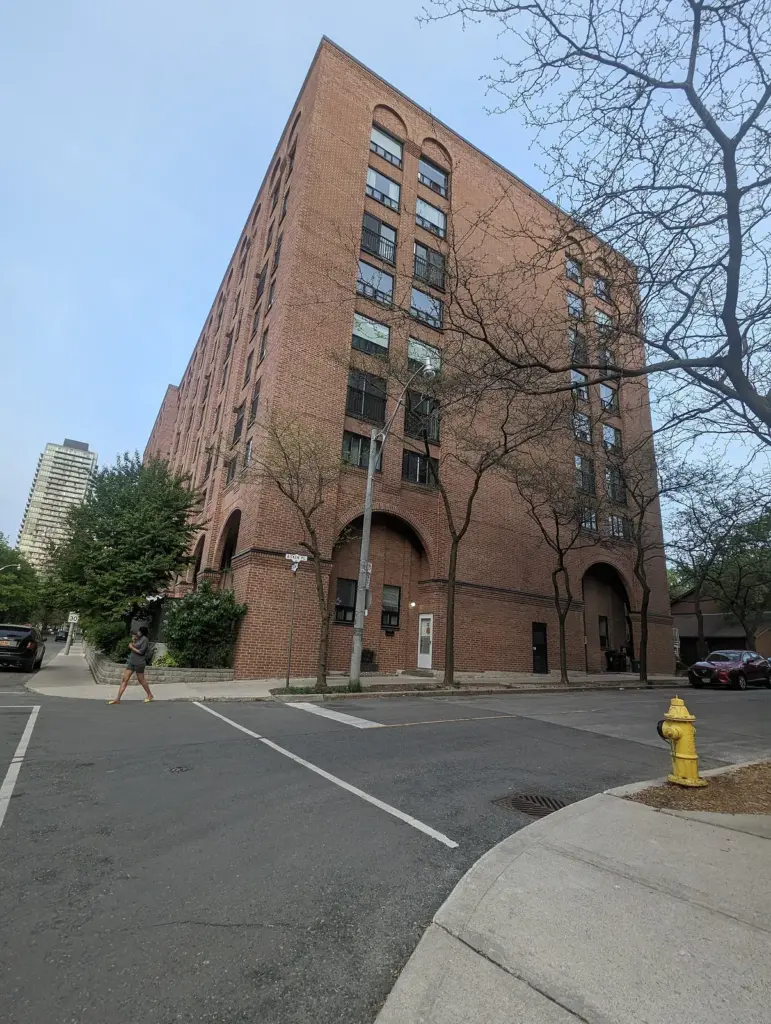
A non-profit housing co-op is owned and operated by the corporation formed by its members. Members elect a board. They vote on major rules, budgets and housing charges.
You do not buy your unit as you would in a condo. You also do not build private equity from rising real estate prices. You receive the right to occupy a home as long as you follow the occupancy agreement and co-op rules.
That difference is the point. A co-op is designed to provide housing, not an investment windfall.


Market units and subsidized units are different searches
Market housing charge
Market members pay the full housing charge set by the co-op. Contact each co-op directly to ask whether it accepts applications and how its list works.
The word "market" does not mean the charge will match a newly listed condo. It means the household does not receive an income-based subsidy. Ask what is included before comparing it with rent. Heat, hydro, parking and laundry can change the real monthly cost.
Rent-geared-to-income housing
RGI housing is normally calculated at about 30 per cent of adjusted household income. Toronto administers access through MyAccessToHousingTO.
The wait is severe. The City's published 2025 average waits were about 10 years for a senior studio, 12 years for a studio, 14 years for a one-bedroom, 12 years for a two-bedroom and 15 years for a home with three or more bedrooms. Those are averages, not promises.
Apply if you qualify, but make another housing plan at the same time.
The correct way to apply for a market co-op
- Open the current CHFT Find a Co-op directory.
- Filter by Toronto and any household needs that the directory offers.
- Make a short list based on unit size, location, transit and accessibility.
- Visit each co-op's own website or use its listed contact.
- Ask whether applications are open. Do not assume an old PDF is still valid.
- Follow that co-op's exact instructions.
- Record the date, contact, unit size and next follow-up in a simple spreadsheet.
- Update the co-op if your phone, email or household size changes.
- Keep searching for regular rentals while you wait.
Do not send the same vague email to 100 buildings. A clear message with your household size, required bedrooms, move timing and accessibility needs is easier to answer.
What the membership interview is really for
Most co-ops meet potential members before signing an occupancy agreement. It is not supposed to be a charm contest. The co-op and applicant are deciding whether the arrangement fits.
Expect questions about household size, ability to pay the housing charge and willingness to follow the bylaws. Some co-ops expect members to join committees, attend meetings or complete a set number of participation hours. Others rely more heavily on paid staff.
Ask direct questions too:
- How many meetings or participation hours are expected?
- Are there penalties for missing participation?
- Which utilities are included?
- How are annual housing charge increases decided?
- What is the repair request process?
- Are pets, smoking, parking or renovations restricted?
- Is the available unit accessible in the way you need?
- Is there a move-in deposit, membership fee or share purchase?
A co-op that cannot explain its finances, maintenance process or member expectations is not a bargain. It is a risk.
20 Toronto co-ops to use as starting points
These are examples from the current CHFT directory, not a list of available apartments. Most showed no vacancies when checked on September 1, 2026. Availability can change, so use the live directory before contacting anyone.
This map shows an approximate area. Open the full map.
| Co-op | Address | Units listed | Best location reason |
|---|---|---|---|
| 15 Thorncliffe Park Co-op | 15 Thorncliffe Park Drive | 75 | Thorncliffe Park services and bus connections |
| 55 Howard Park Co-op | 55 Howard Park Avenue | 89 | Close to Dundas West Station and Roncesvalles |
| 91 Spencer Ave Co-op | 91 Spencer Avenue | 73 | Parkdale, near King and Queen streetcars |
| Agincourt Co-op | 4675 Sheppard Avenue East | 52 | Scarborough access near Sheppard and McCowan |
| Alexandra Park Co-op | 25 Eden Place | 104 | Downtown west near Kensington Market |
| Arcadia Co-op | 680 Queens Quay West | 110 | Waterfront location and streetcar access |
| Barsa Kelly/Cari-Can Co-op | 1 Coin Street | 133 | South Etobicoke near the lake |
| Beaver Hall Artists Co-op | 29 McCaul Street | 24 | Small artist co-op beside OCAD University |
| Beech Hall Co-op | 2 Humber Boulevard | 128 | Mount Dennis area and Weston Road buses |
| Birch Cliff Co-op | 1691 Kingston Road | 310 | Large east-end co-op on Kingston Road |
| Caroline Co-op | 93 Longboat Avenue | 60 | St. Lawrence neighbourhood |
| Cawthra Mansions Co-op | 215 College Street | 84 | College Street beside the university district |
| David B. Archer Co-op | 158 The Esplanade | 190 | Large central co-op near St. Lawrence Market |
| Diane Frankling Co-op | 85 Bleecker Street | 254 | Large downtown co-op in St. James Town |
| Don Area Co-op | 255 Carlton Street | 75 | Cabbagetown and Carlton streetcar access |
| Dufferin Grove Co-op | 31 Melbourne Avenue | 62 | West Queen West and Dufferin access |
| Duncan Mills Co-op | 2040 Don Mills Road | 221 | Large North York community near Don Mills |
| Hugh Garner Co-op | 550 Ontario Street | 181 | Cabbagetown, close to Wellesley buses |
| Jarvis-George Co-op | 279 Jarvis Street | 107 | Downtown location near TMU and Dundas |
| Woodsworth Co-op | 133 Wilton Street | 194 | Established St. Lawrence neighbourhood co-op |
Do not choose by neighbourhood alone. A smaller co-op may rarely turn over units. A larger one may have more movement but also more applicants. Neither is automatically easier.
What does a Toronto co-op cost?
There is no useful citywide average for market housing charges. Buildings differ in age, mortgage status, reserve funds, utilities and capital repairs. A five-year-old screenshot is not a current price.
Ask for the exact current charge and the most recent approved increase. Then add:
- electricity, heat and water not included
- parking
- laundry
- internet
- membership or share amount
- moving fees
- insurance
- transit cost from the location
The honest comparison is total monthly cost, not the number in the first email.
Are housing co-ops protected by rent control?
Do not assume normal rental rules apply. The City states that co-ops are not landlords and the Residential Tenancies Act generally does not govern their operations. Parts of the Landlord and Tenant Board process apply to evictions.
Housing charges are approved through the co-op's governance process. Members can vote, review audited statements and approve budgets, but that does not mean charges can never rise.
Read the occupancy agreement and bylaws before accepting a unit. For a serious dispute, get advice from a community legal clinic familiar with co-operative housing.
.jpg)
The good parts people undersell
Stable membership can make a building feel less temporary. Members can vote on decisions that would normally be made by a distant landlord. Many co-ops have shared spaces, committees and neighbours who know one another.
The model can also preserve mixed-income housing in areas where regular rents have climbed quickly.
For a household that wants to stay for years and take part, this can be better than a slightly cheaper private rental.
The bad parts people avoid saying
Participation can become unpaid work. Meetings can be slow. Board politics can become personal. A poorly governed co-op can delay repairs or make simple decisions exhausting.
You may have fewer familiar renter remedies. You also cannot cash out rising property value when you leave.
Most importantly, the supply is tiny compared with demand. A person can do everything correctly and still receive no offer.
Red flags before you accept a unit
Skip or investigate further if:
- staff will not show you the occupancy agreement before signing
- member duties are vague
- major repairs are visible but the reserve plan is unclear
- the board cannot explain recent housing charge increases
- you are asked to pay a large unofficial application fee
- someone promises a subsidized unit in exchange for money
- a supposed listing is not connected to the co-op's official contact
- accessibility is described only as "probably fine"
Never send a deposit because a stranger says they can move you up a wait-list.
How to improve your chances without gaming the system
Apply to several suitable co-ops, including areas outside your first-choice neighbourhood. Keep your household details current. Reply quickly when a co-op contacts you. Attend an information session if offered.
Do not pretend you love committee work if you will not do it. A truthful fit is better for both sides.
For RGI, complete every required annual review and choice cycle. Missing notices can damage an application that has already waited years.
If you need housing now
A co-op list will not solve an immediate crisis. Use the City's housing help, eviction prevention and shelter resources as needed. Search regular rentals, non-profit housing and purpose-built rental buildings at the same time.
Our pick is still to apply to co-ops. Just treat the application as one track in a wider plan.
Keep exploring Toronto
- A realistic budget for raising a child in Toronto
- The Toronto recession warning signs worth watching
- Toronto versus New York City as a place to live
Official pages to check
Prices, rules, hours and project details can change. Check these primary pages before you spend money or make a special trip:
- City of Toronto, Co-operative Housing Information
- Co-operative Housing Federation of Toronto, Find a Co-op
- City of Toronto, Rent-Geared-to-Income Subsidy
- City of Toronto, RGI How-to Guide
Frequently asked questions
Can anyone apply to a Toronto housing co-op?
Market-unit rules vary by co-op. RGI applicants must meet the City's income, asset and household eligibility rules. At least one household member must generally be 16 or older and able to live independently, with or without support.
Is there one application for every Toronto co-op?
No. Contact individual co-ops for full-market housing charges. Use MyAccessToHousingTO for rent-geared-to-income housing.
How long is the wait for a Toronto co-op?
There is no honest single number for market co-ops. Many lists are closed or have no vacancy. City RGI averages published for 2025 ranged from about 10 to 15 years by unit type.
Are co-op homes always cheaper than rentals?
No. Some are excellent value, while others have charges close to local rents. Compare utilities, condition, location and participation duties as well as the monthly number.
Can a co-op evict a member?
Yes. The process differs from an ordinary tenancy, and parts of the Landlord and Tenant Board process apply. Read the bylaws and get legal advice for an active case.
Do I have to volunteer in a co-op?
It depends on the co-op's bylaws and policies. Some expect committee work or participation hours. Ask for the written requirement before accepting a home.
Does CHFT control Toronto co-op wait-lists?
No. CHFT provides a directory and support to member co-ops. It does not accept housing applications or administer their wait-lists.
What is the best first step?
Open the live CHFT directory and choose ten realistic co-ops. Contact each one using its current official details, then track every answer in one document.