


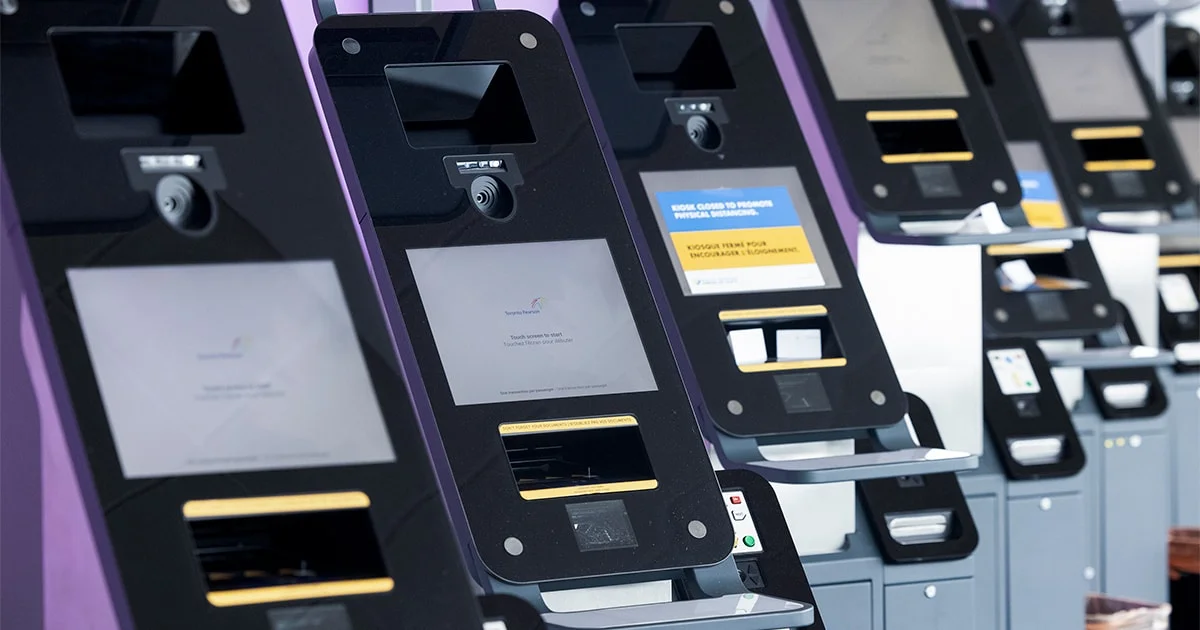
A quick trip through Pearson arrival kiosks does not mean you missed border processing. The kiosk handles part of the process before the officer sees you. Follow the prompts, keep the receipt and follow the officer's directions.
The important limit is your own purpose of travel. A short routine arrival is not proof that a work permit, study permit or other special request has been dealt with. Tell the officer if you need something beyond ordinary entry processing.
What the kiosk does
CBSA's kiosk guide lists primary inspection kiosks at Pearson Terminals 1 and 3, with eGates at Terminal 1.
At a kiosk, travellers scan their travel document, have a photo taken and answer the questions. The step-by-step instructions then tell travellers to take the receipt to the border services officer.
That is why a brief officer interaction can still be part of a normal process. Don't use the number of spoken questions as a test of whether you were processed properly.
CBSA's privacy explanation describes how the system handles the information and photo. Read that page if your question is about the technology rather than the queue.
Follow the route for your group and documents
Eligibility rules differ between kiosks and eGates. The eGate route is for eligible travellers aged 14 and older. Families and other groups should follow the signs and staff directions for their situation.
If you need a passport stamp, ask the officer. Don't assume that no stamp means no recorded entry.
If you need a permit issued, have questions about your authorized stay or think an important step was missed, speak to CBSA before leaving the controlled arrivals area. A general airport guide cannot confirm your personal immigration status.
Advance Declaration is optional preparation
Advance Declaration lets eligible travellers submit a customs and immigration declaration through ArriveCAN within 72 hours before arrival.
It is optional. It does not remove your duty to check that the information is correct or follow the arrival process. Nor does it promise a five-minute exit from Pearson.
Complete the optional declaration only through the official ArriveCAN service. Review the flight and arrival details and update inaccurate answers at the airport. A changed flight or changed contents of a bag can make an earlier answer wrong.
Do not pay a third-party site merely to access the government's declaration service. Start from the official Canada.ca page linked above. Save the relevant confirmation somewhere you can reach without relying on a weak airport connection.
Advance work can reduce time spent entering information. It cannot control the number of arriving flights, staffing, baggage delivery or whether your case needs additional review. Plan your onward travel with those separate uncertainties in mind.
Keep your travel documents and any supporting papers easy to reach. After processing, follow the baggage and exit instructions for your arrival. A smooth queue is good news, but the right question is whether you completed the steps for your trip, not how long you spent talking.
The normal arrival sequence, without the mystery
The exact route depends on your flight, terminal and processing instructions. In general, follow signs for Canadian arrivals, complete the declaration and identity steps, speak with the officer as directed, collect bags where required and follow the exit instructions.
Keep your receipt until staff take it or tell you what to do with it. Do not walk past a checkpoint because someone ahead had a shorter conversation. Processing can differ between people on the same flight.
If a screen gives an error or you cannot use the equipment, ask the staff nearby. Repeatedly choosing answers just to get past a screen is worse than requesting help. The declaration needs to be accurate.
Four things travellers often confuse
| Document or step | What it does not prove by itself |
|---|---|
| Kiosk receipt | That every separate permit request has been completed |
| Advance Declaration | That you have been admitted before landing |
| A visa or eTA | That no examination or further document check is needed |
| A port-of-entry introduction letter | That the actual work or study permit has already been issued |
These are different parts of travel and border processing. Do not use one as a substitute for another because they all appear in the same trip folder.
First arrival with a work or study permit approval
IRCC explains that a port-of-entry letter is not the permit itself. Tell the officer about the approved application and present the letter along with the required travel documents.
Keep the documents in hand luggage. For a study-permit arrival, use IRCC's current instructions, including the supporting documents relevant to your approval. Do not rely on a generic packing list from someone with a different status.
Before leaving the processing area, read any permit issued to you. Check your name, dates and printed conditions. Ask the officer about a possible error while you are still there. A later correction process is not the same as fixing a question at the counter.
A returning permit holder and a person arriving for first issuance may need different steps. State your situation plainly. This guide explains the process; the officer and current IRCC rules determine the requirements for your case.
What to declare: do not guess from a friend's trip
Food, plant and animal products, purchases and other controlled goods can need declaration. Use CBSA's travel guidance for the current rules and the questions shown at arrival.
“Allowed” and “does not need declaring” are not the same thing. If you are unsure about something in a bag, tell the officer what it is. Do not assume that a small amount, a gift or food from an airport shop is automatically exempt.
Personal exemptions also depend on the traveller and circumstances. A returning Canadian resident's allowance is not a universal rule for every visitor or newcomer. Keep receipts accessible when relevant.
If you notice a mistake after submitting the kiosk answers, tell the officer. A submitted answer is not a reason to stay silent about an error.
Families, groups and assistance
CBSA says up to five travellers can use one kiosk to submit declarations. eGates process people individually. Follow staff directions and eligibility rules for your group rather than splitting up solely because a lane looks faster.
Ask for assistance if the screen, language, height or physical process is difficult. Leave enough time for a supported route rather than assuming the automated lane is the only option.
Keep everyone's travel documents organized so they do not get mixed up at the machine. Check that the receipt and any directions apply to the right travellers before moving on.
No stamp, a short conversation or a second inspection
A brief exchange is not proof that something was missed. Equally, a longer inspection is not proof that a traveller has done something wrong. Answer the questions and follow the instructions for your own arrival.
If you need documentary proof of a date, ask the officer about the appropriate record. Do not invent a stay expiry by counting from a remembered conversation. Check the documents and official rules that apply to your status.
If you are directed to another area, go there before exiting. Tell staff if you are worried about a connection or checked baggage, but do not skip a required step to catch a train or flight.
Plan the part after customs too
Meeting someone outside arrivals is easier when you agree on the terminal and a contact method in advance. A landing time is not a curbside pickup time. Let the person know when you have completed processing and collected what you need.
For a connecting flight, follow the airport and airline's instructions for that itinerary. Some connections have a different baggage or security route from a passenger ending the trip in Toronto. Confirm rather than following a crowd heading to the exit.
Keep essential medicine, charging equipment and the documents you need next in your carry-on. Do not put the only copy of a permit approval or onward booking into a checked suitcase.
The useful question at Pearson is not “Was that too easy?” It is “Did I complete the steps for my travel purpose, and do I understand the documents I was given?” Settle that before leaving arrivals.
Getting into Toronto after the border check
For central Toronto, UP Express is the simpler rail option; the TTC is the budget choice. Choose for the address you need, not just the word “downtown.”
UP Express's current Pearson-to-Union adult fare is $9.25 with PRESTO or contactless debit/credit. Tap on and off using the same card or wallet. A physical card and its phone-wallet version are different payment methods. Discounted passenger fares have their own eligibility rules.
The 900 Airport Express connects Terminal 1's ground level and Terminal 3's arrivals level with Kipling station on Line 2. TTC lists the bus ride at roughly 20 to 25 minutes; the subway and final connection add time.
The adult TTC fare is $3.30 with PRESTO or debit/credit, or $3.35 cash. The electronic fare includes a two-hour transfer when you use the same payment method. Check the route's operating hours before a late or early arrival.
For Terminal 3 arrivals choosing UP Express, take Pearson's free Terminal Link train to Terminal 1, then follow the Train to City signs. Do not buy a tight onward ticket from the landing time: border processing and baggage are separate waits.
Frequently asked questions
Does the kiosk replace every interaction with an officer?
No. CBSA’s instructions include presenting the kiosk receipt to an officer. Follow staff directions even if the interaction is short.
Are kiosks in both Pearson terminals?
CBSA lists kiosks at Terminals 1 and 3. Its eGate listing is for Terminal 1.
Can children use eGates?
The published eGate age threshold is 14. Follow the kiosk or family processing instructions that apply to your group.
Is ArriveCAN Advance Declaration mandatory?
No. The advance declaration service is optional. You still need to complete the arrival process and provide accurate information.
What if I need a permit or a passport stamp?
Tell the border officer about that need. Do not assume that a routine kiosk receipt settles a separate permit or document request.