

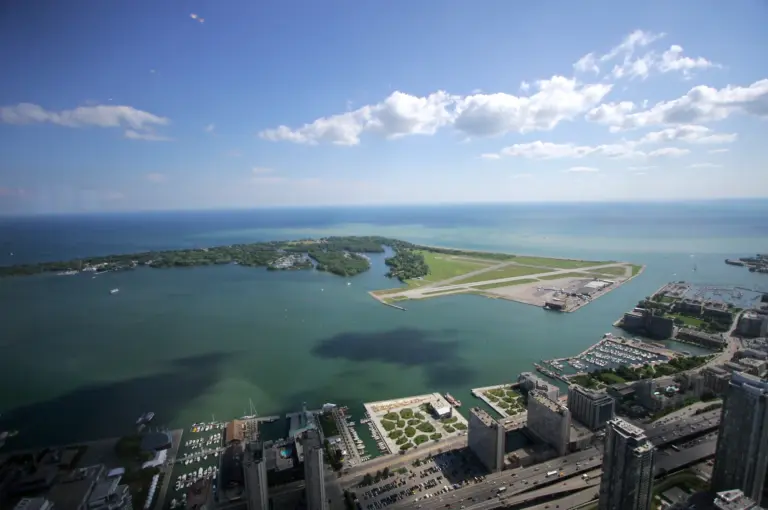

Toronto still has no operating passenger ferry to Niagara because the boat is the easy part. A useful service also needs two terminals, transit at both ends, winter reliability, safety approval, enough daily riders and fares people will actually pay.
Hoverlink is a real proposal for Toronto to St. Catharines. It is not running. Toronto City Council documents say the earliest proposed start is the first quarter of 2028, with another City update due in the second quarter of 2027. Do not plan a trip or commute around it yet.
Our verdict is cautiously positive. A fast cross-lake service could be excellent for some commuters and visitors. The biggest weakness is the last kilometre. Port Weller is not Niagara Falls or Niagara-on-the-Lake, and the Toronto terminal would add another connection near Billy Bishop Airport.
What is actually being proposed?
Hoverlink Ontario proposes a high-speed hovercraft between Toronto and St. Catharines. The company says the crossing would take about 30 minutes, operate year-round and carry up to 180 passengers.
On the Toronto side, the proposed terminal is on the south side of the Western Gap at Billy Bishop Toronto City Airport. Passengers would reach it through the airport ferry or pedestrian tunnel system.
On the Niagara side, the proposed service and maintenance base is in St. Catharines near Port Weller. That is on Lake Ontario. It is not Niagara Falls. It is also not the tourist centre of Niagara-on-the-Lake.
Toronto Council adopted a motion on April 1, 2026 asking City staff for a project update. The official Council item records the first quarter of 2028 as the earliest proposed launch.
The verdict: call it the proposed Toronto to St. Catharines hovercraft. Calling it a Niagara Falls ferry makes the trip sound simpler than it would be.
The proposal at a glance
| Claim or fact | Current position checked August 31, 2026 | Our judgement |
|---|---|---|
| Route | Billy Bishop Airport area to Port Weller, St. Catharines | Useful waterfront link, not direct to the Falls |
| Crossing time | Operator says about 30 minutes | Plausible target, not proven scheduled time |
| Vessel | Operator says up to 180 passengers | Capacity claim needs final vessel and approval |
| Frequency | Operator says up to 48 crossings a day | Maximum claim, not a published timetable |
| Operating day | Operator says up to 18 hours | Needs crew, terminal and maintenance plan |
| Seasons | Operator says year-round | The hardest promise and the one to test |
| Earliest opening | City record says first quarter of 2028 | A target, not a booking date |
| Next City update | Second quarter of 2027 | The next serious checkpoint |
| Public fare | Not dependable or final | Impossible to judge value yet |
| Niagara connections | Not published as a complete timed network | The largest unresolved weakness |
The operator's website is the correct source for what the company wants to build. It is not independent proof that every performance, environmental or ridership claim will be achieved.
The verdict: the route has reached the serious-proposal stage, not the travel-planning stage.
This map shows an approximate area. Open the full map.
Why a ferry sounds like an obvious idea
Toronto and Niagara face each other across Lake Ontario. Driving around the lake can take two hours or much longer in traffic. GO train service helps, but schedules and the final trip to a winery, campus or workplace still matter.
A 30-minute water crossing could offer real benefits:
- A trip that avoids the Queen Elizabeth Way.
- A new option for St. Catharines and Toronto commuters.
- Better access to Niagara tourism without driving the full route.
- A useful connection for some Brock University and Niagara College trips.
- Less exposure to highway collisions and traffic delays.
- A memorable lake trip rather than a long drive.
The idea returns because the geography keeps making sense. The operation keeps failing because geography is not a business model.
The last connection can erase the time saving
Thirty minutes is only the water crossing. A passenger must reach the Toronto terminal, board, cross, leave Port Weller and then reach the real destination.
Consider a trip from midtown Toronto to Niagara Falls. It could include TTC to downtown, a walk through the Billy Bishop connection, check-in, boarding time, a 30-minute crossing, unloading, then a bus or car from north St. Catharines to the Falls. The full door-to-door trip may still be long.
This is the biggest weakness raised whenever Torontonians discuss the idea. People want a ferry to Niagara-on-the-Lake or Niagara Falls. The practical terminal is elsewhere.
The service needs a timed local connection. That could be a frequent bus to downtown St. Catharines, Niagara-on-the-Lake and Niagara Falls. It also needs space for taxis, rideshare pickup and bikes. A boat that arrives before the bus leaves is not rapid transit.
The verdict: do not judge the project until the full connection plan is public.
Compare door to door, not water to rail
A fair comparison starts at home and ends at the real destination. The table below shows the steps, not a promised travel time.
| Trip | Steps a traveller must count |
|---|---|
| Proposed hovercraft to downtown St. Catharines | Travel to Billy Bishop area, tunnel or airport ferry, check-in, boarding, crossing, unloading, local ride from Port Weller |
| Proposed hovercraft to Niagara Falls | All hovercraft steps, then a much longer road or transit trip south to the Falls |
| GO to Niagara Falls | Travel to Union, waiting, train or bus trip, then local walk or WEGO connection |
| Car to Niagara Falls | Walk to parking, drive around Lake Ontario, traffic, parking and final walk |
| Tour bus | Reach pickup point, check-in, highway trip and fixed itinerary |
The hovercraft can win for a rider near both waterfront endpoints. It may lose for someone in North York going to the Falls. A Toronto resident west of downtown may reach Union more easily than the airport-side terminal. A St. Catharines resident near Port Weller may save far more time than one living in south Niagara.
Our benchmark would be a published ninety-percentile door-to-door time. That shows what most riders can expect, not only the perfect trip when every connection lines up.
The verdict: a 30-minute crossing is impressive and incomplete.

Why the Toronto terminal is also awkward
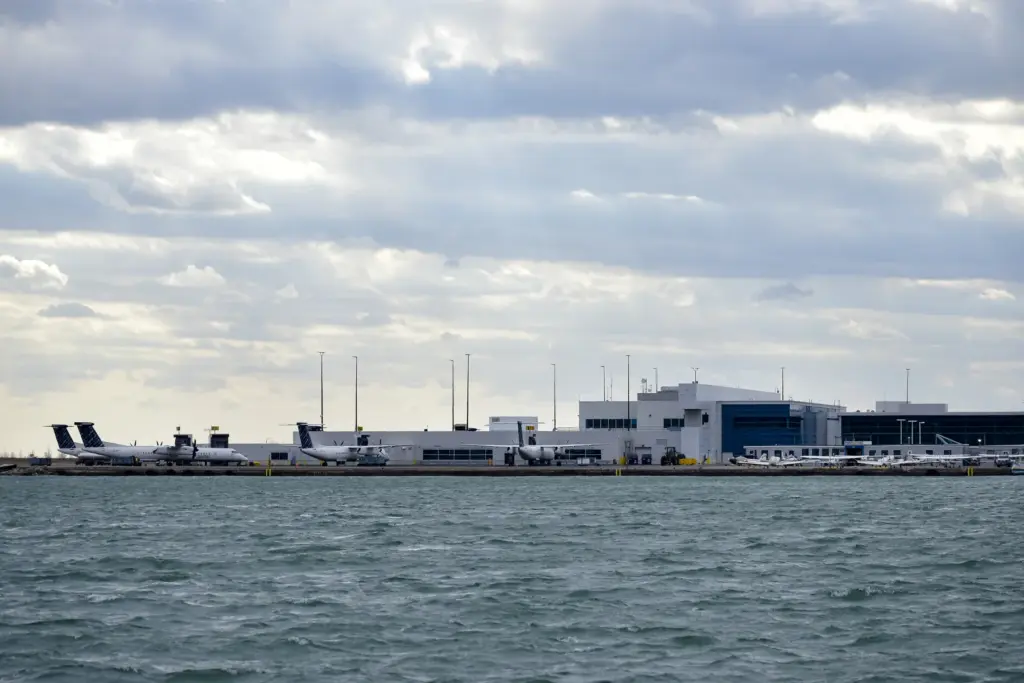
Billy Bishop Airport is close to downtown, but the proposed hovercraft terminal would be on the airport side of the Western Gap. A passenger would first use the pedestrian tunnel or short airport ferry connection.
That can work. Airport passengers already make the trip. It also creates another transfer and a possible crowding point.
The Toronto side needs clear answers:
- Will hovercraft passengers use the existing tunnel without an airline ticket?
- How long is the walk with bags?
- Will security or check-in add time?
- Is the airport ferry part of the fare?
- What happens during tunnel maintenance?
- Where do taxis and TTC passengers start the trip?
- Is the route fully accessible?
The verdict: the terminal location is central on a map and less simple on foot.
Port Weller needs a real transit hub, not a shuttle promise
Port Weller is in north St. Catharines. A successful terminal needs more than a rideshare pin.
At minimum, the launch plan should include:
- A timed bus to downtown St. Catharines and its transit connections.
- A clear Niagara Falls connection with travel time and fare.
- A Niagara-on-the-Lake connection during visitor season.
- Safe bicycle storage or bicycle carriage.
- An accessible pickup area with shelter and seating.
- Taxi and rideshare space that does not block buses.
- A plan for a full 180-passenger arrival.
- Late service when the final sailing is delayed.
One small shuttle cannot absorb a full boat. If four buses are needed, they must be waiting. If most passengers use cars, the terminal needs parking and road capacity, which weakens the low-carbon argument.
The verdict: onward transport is part of the ferry. It cannot be added as an afterthought.
Lake Ontario is not calm every day
A hovercraft can operate in conditions that stop some conventional vessels. That does not mean weather stops mattering.
Wind, waves, fog, ice, freezing spray and severe storms can affect comfort, speed and service. A commuter product needs a clear cancellation policy and a backup route. A tourist can move a trip. A nurse or office worker cannot regularly arrive two hours late.
The operator needs to publish operating limits, winter performance, accessibility in rough conditions and how passengers get home after a cancellation.
Motion sickness matters too. A 30-minute crossing can feel much longer when the lake is rough. The marketing should show an ordinary windy day, not only flat blue water.
The verdict: year-round is a claim to prove with operations, not a phrase to repeat.
Reliability must be published in numbers
The operator should eventually report:
| Reliability measure | Why riders need it |
|---|---|
| Percentage of scheduled trips completed | Shows whether the service actually runs |
| On-time arrival rate | Shows whether commuters can trust it |
| Weather cancellations by month | Tests the year-round claim |
| Mechanical cancellations | Shows vessel and maintenance resilience |
| Average delay and worst regular delay | Helps people plan connections |
| Replacement transport time | Shows what happens after cancellation |
| Refund processing time | Shows whether riders carry the disruption cost |
A single vessel creates obvious risk. If it fails, the route can disappear. Multiple vessels improve resilience but increase capital, crew and maintenance costs. The final fleet plan matters.
The verdict: no reliability data, no dependable commute.
Toronto tried fast cross-lake service before
Fast passenger service across Lake Ontario is not a new dream. In 1998, a hydrofoil operated between Toronto and Port Dalhousie. A Transportation Safety Board marine investigation report describes a rough-water incident that damaged a window and injured one passenger. The vessel carried up to 66 passengers and the advertised trip was about one hour.
That incident does not prove a modern hovercraft will fail. It proves the lake, vessel and operating limits require serious work.
Older services have also struggled with ridership, financing and short operating seasons. A new company must show why its cost, vessel and market are different.
Hoverlink itself announced in September 2022 that it expected service in summer 2023. That launch did not happen. Projects change, permitting takes time and a missed old target does not prove the current proposal will fail. It does prove that a press release is not a schedule.
The verdict: history should make the project better prepared, not automatically rejected.


How much would a Toronto Niagara ferry cost?
No dependable public passenger fare was available when this guide was checked. That missing number is critical.
The fare has to compete with several different trips:
- A GO train or bus passenger travelling alone.
- Two adults sharing a car and parking cost.
- A tourist buying a day excursion.
- A commuter making the trip many times each month.
- A family of four.
A $40 one-way fare might look reasonable beside a solo drive. It can become $320 return for a family of four before local transport in Niagara. A low launch fare may also be unsustainable after fuel, crew, maintenance, terminal and financing costs.
The operator should publish a normal fare, commuter pass, child fare, bike fee, luggage rules, refund rules and total checkout fees. Until then, any value claim is speculation.
For a current reference, GO Transit's Toronto-Niagara packages were advertised at $34 for a one-day round trip with 24 hours of WEGO bus access, and $40 for a two-day round trip with 48 hours of WEGO plus the Falls Incline Railway, when checked. Offers, schedules and conditions can change, so use the official GO Niagara page.
The ferry does not have to beat GO on price for every rider. It can charge more for speed and the experience. But a premium fare needs a large, reliable time saving after every transfer.
The verdict: wait for the real fare. A 30-minute trip that most families cannot afford is not a broad transport solution.
Capacity claims need plain arithmetic
The operator says a vessel could carry up to 180 passengers and the service could make up to 48 crossings per day. Those are maximums. They do not reveal the normal timetable or average ridership.
Forty-eight crossings also needs careful language. If one movement across the lake counts as one crossing, the number includes travel in both directions. It does not necessarily mean 48 Toronto departures and 48 Niagara departures.
Public planning should show:
- Seats offered in each direction by hour.
- Expected average load, not only full capacity.
- Peak summer and low winter demand.
- Vessel turnaround and charging or fuelling time.
- Crew shifts and maintenance windows.
- The number of spare sailings or vessels.
- How reservations and walk-up riders are balanced.
The verdict: large daily numbers are marketing until the timetable explains them.
Would people commute on it?
Some would. A person living near the St. Catharines terminal and working near Toronto's waterfront could save time. The route may also suit a hybrid worker travelling once or twice a week.
It is weaker for a daily rider who needs two long local connections. Weather uncertainty, missed departures and the cost of monthly travel all matter.
Commuters need an early first sailing, a late final sailing and enough frequency to recover from a missed trip. One departure every few hours is a tour service, not useful rapid transit.
The public business case should show expected ridership by purpose, not one large annual number. Tourists and commuters travel at different times and pay differently.
The verdict: the best commuter market is narrow but real. Frequency will decide whether it grows.
Who is the service actually best for?
Best fit:
- A St. Catharines resident near Port Weller working near Toronto's waterfront.
- A hybrid worker making one or two predictable trips a week.
- A Toronto visitor building a full Niagara trip around timed transport.
- A leisure rider who values the crossing itself.
Weak fit:
- A daily commuter with long local trips at both ends.
- A family going to Niagara Falls when the fare is high.
- A traveller with a flight, appointment or event that cannot survive a cancellation.
- A Niagara-on-the-Lake visitor without a booked onward ride.
- Anyone assuming the boat docks beside the Falls.
The verdict: the route solves a narrow travel problem extremely well if the connections work. It does not replace the QEW or GO for all of Niagara.
Would it help Niagara tourism?
Yes, if the connection after Port Weller is easy. A visitor should be able to buy one clear trip to Niagara-on-the-Lake or Niagara Falls. A confusing mix of hovercraft, local bus and rideshare weakens the benefit.
The route could be especially attractive during Toronto events, Niagara wine weekends and highway construction. Bikes could open a useful touring market if the vessel and local roads support them.
But a water trip also creates expectations. Visitors may imagine stepping off beside wineries or the Falls. Marketing must name the terminal honestly and show onward travel time.
For a current land option, compare the GO schedule and a day-trip plan. Our guide to GO train day trips from Toronto helps with trips that already work.
The verdict: sell the full Niagara trip, not only the lake crossing.
Accessibility, luggage and bikes need exact rules
"Accessible" should mean the entire trip, not only a ramp onto the vessel. The public needs to know about the tunnel or airport ferry, terminal distance, boarding slope, washrooms, mobility-device spaces, rough-water seating and assistance during a cancelled trip.
Families need stroller rules. Travellers need luggage size and fee rules. Cyclists need the number of bookable bicycle spaces and whether e-bikes are accepted. Service-animal and pet rules must be clear.
A person should be able to book a mobility space online without making several calls. The onward Niagara bus must offer the same level of access or the route is broken at arrival.
The verdict: accessibility is a route property, not a vessel feature.
Treat the environmental claim as unproven for now
Hoverlink promotes major carbon savings, including a claim of up to 98 percent less carbon than alternative trips. That figure needs a public method before we repeat it as a result.
The comparison should disclose:
- The vessel energy source and real fuel or electricity use.
- Average passenger load used in the calculation.
- The car, bus or rail trip used as the baseline.
- Empty return trips and maintenance travel.
- Terminal energy and onward buses.
- Whether the result is per passenger or per vessel trip.
A nearly empty low-emission vessel can perform badly per passenger. A full vessel can perform well. A claim against a solo gasoline car will look different from a claim against an electric GO train.
The verdict: support lower-emission transport, but demand the calculation.
Why Toronto does not have more commuter ferries
Water looks like an empty road. It is not free infrastructure.
Passenger ferries need docks, safe approaches, vessels, crew, maintenance, winter plans and transport connections. Toronto's most useful jobs and homes are spread beyond the shoreline. A subway or GO line can collect riders along the route. A ferry mostly connects two fixed waterfront points.
Waterfront Toronto has studied and tested local water shuttle ideas. Its east-west water shuttle pilot shows interest in water transport, but a short urban shuttle is a different product from a cross-lake service.
The verdict: ferries work best where both ends are strong destinations. Toronto to Port Weller still has to prove that.
What would make us trust the launch
We would want to see all of this before calling it real:
- A firm operating approval and vessel plan.
- Completed terminal agreements at both ends.
- A published construction and testing timeline.
- A normal fare with all fees.
- A real schedule, including winter and weekend service.
- Timed onward transport in Niagara.
- Accessibility and bike rules.
- Cancellation, refund and backup policies.
- A ticket page taking bookings for confirmed dates.
- A published last-mile transit contract.
- Demonstration trips in winter conditions.
- Public fare, accessibility and emissions methods.
Hoverlink's older FAQ has carried dates that did not happen. That does not prove bad faith. It does mean a new date should be treated as a target until construction, testing and tickets make it firm.
The final verdict: the idea is good enough to support and uncertain enough to doubt. Check again after the City's 2027 update.
Frequently asked questions
Is there a ferry from Toronto to Niagara Falls?
No. There is no operating passenger ferry from Toronto to Niagara Falls. Hoverlink proposes a Toronto to St. Catharines service, with onward travel still required.
When will Hoverlink start?
Toronto Council records the first quarter of 2028 as the earliest proposed start. That is a target, not a confirmed operating date.
How long would the Toronto Niagara hovercraft take?
Hoverlink says the water crossing would take about 30 minutes. Door-to-door travel would be longer because passengers must reach both terminals and continue from Port Weller.
Will the ferry go to Niagara-on-the-Lake?
Not directly under the current proposal. The Niagara-side terminal is planned for St. Catharines near Port Weller. Niagara-on-the-Lake would require a road connection.
How much will the Toronto Niagara ferry cost?
A dependable public normal fare was not available when checked on August 31, 2026. Do not judge value from an old promotional number.
Will the hovercraft run in winter?
Hoverlink says it intends year-round operation. Actual weather limits, cancellation rates and winter performance still need to be proven in service.
Can I take a bike on Hoverlink?
Do not assume it. Wait for final luggage and bicycle rules from the operator before planning a cycling trip.
What is the best current no-car trip to Niagara?
Use current GO Transit train or bus service, a tour or a combination of rail and local transit. Compare the exact schedule with your destination because Niagara Falls, Niagara-on-the-Lake and St. Catharines are separate trips.