

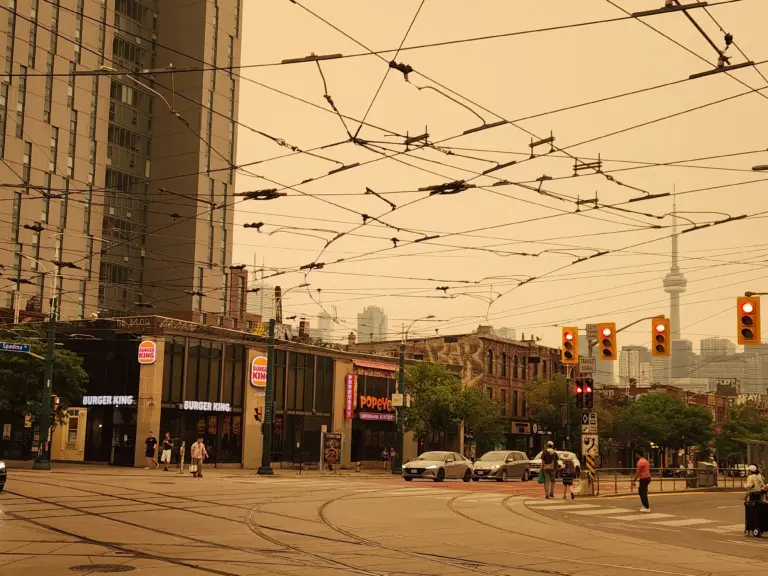

Do not push through a smoky Toronto day to save an outdoor plan. Check the Air Quality Health Index, move hard exercise indoors and choose a building with known filtration. A mall is not automatically clean air. The City lists six civic cleaner-air spaces with MERV 13 filtration.
Our best public option is the nearest listed civic building, not the fanciest attraction. City Hall has the longest stated daily hours in the downtown core. The best home step is one closed room with a correctly sized portable air cleaner. The biggest deal-breaker is heat. A sealed room that becomes dangerously hot is not safe.
This guide is general health information. Follow current alerts and your health professional's advice. Trouble breathing, chest pain, severe weakness, confusion or blue lips need urgent medical help. Call 911 for an emergency.
First, check the AQHI and the actual smoke
Use the official Ontario Air Quality Health Index and current City or Environment Canada alerts. The AQHI runs from 1 to 10+, with higher numbers meaning greater health risk.
Do not rely on the colour of the sky alone. Smoke can affect air before it looks dramatic. It can also smell lighter while fine particles remain high.
Your symptoms matter too. Headache, cough, eye irritation, wheezing and shortness of breath are signals to reduce exposure. Children, older adults, pregnant people, people with heart or lung conditions and outdoor workers can be at higher risk.
The verdict: if the AQHI is high or you feel symptoms, move the plan. The ticket is not more important than your lungs.
What the AQHI numbers mean
Canada groups the Air Quality Health Index into four risk levels. Follow the current message shown with the index because advice can differ for people at higher risk.
| AQHI | Risk level | Sensible plan |
|---|---|---|
| 1 to 3 | Low | Normal plans are usually reasonable unless symptoms or a separate alert say otherwise |
| 4 to 6 | Moderate | Watch symptoms and let higher-risk people reduce or reschedule hard outdoor activity |
| 7 to 10 | High | Reduce or move strenuous outdoor plans, especially for higher-risk people |
| 10+ | Very high | Avoid strenuous outdoor activity and reduce exposure as much as practical |
Toronto's wildfire strategy uses a Yellow warning when a forecast AQHI of 7 or higher is expected, and an Orange warning at 10 or higher. The City can activate public messaging and cleaner-air measures based on the event.
The AQHI is a forecast and health communication tool. A number can change by hour and location. Check again before leaving, not only the night before.
The verdict: AQHI 7 is the point to rewrite an outdoor day, not the point to debate the colour of the sky.
Toronto's official cleaner-air spaces
Toronto's Wildfire Air Quality Strategy lists civic buildings with MERV 13 filtration. The City says they are available during regular operating hours for people who need cleaner indoor air.
| Cleaner-air space | Address | Listed hours checked August 31, 2026 |
|---|---|---|
| Toronto City Hall | 100 Queen Street West | Monday to Friday 8 a.m. to 8 p.m., Saturday 10 a.m. to 6 p.m. |
| Metro Hall | 55 John Street | Monday to Friday 8 a.m. to 6 p.m. |
| North York Civic Centre | 5100 Yonge Street | Monday to Friday 7:30 a.m. to 9:30 p.m., weekends 8 a.m. to 6 p.m. |
| Scarborough Civic Centre | 150 Borough Drive | Monday to Friday 8 a.m. to 6 p.m., Saturday 10 a.m. to 6 p.m. |
| York Civic Centre | 2700 Eglinton Avenue West | Monday to Friday 8 a.m. to 5 p.m. |
| East York Civic Centre | 850 Coxwell Avenue | Monday to Friday 8 a.m. to 6 p.m. |
Hours can change for holidays, emergencies and building operations. Check the City page the day you need it.
This map shows an approximate area. Open the full map.
These are not overnight shelters. They are places to reduce exposure for part of the day. Bring medication, water, a charger and quiet work.
The verdict: go to the closest listed space. Do not cross the city through smoke for a prettier lobby.
What to do at home
Close windows and doors when outdoor air is worse. Set a central HVAC system to recirculate if that option is available. Use the highest-efficiency filter the system can safely handle, following the equipment instructions.
Run a certified portable air cleaner in the room where you spend the most time. Match its clean-air delivery rate to the room size. Close the door. Keep the intake and outlet clear.
Avoid adding indoor particles. Do not smoke, burn candles, use a wood fireplace or fry food heavily. Vacuuming without good filtration can stir dust. Wipe surfaces and cook with lower-particle methods.
If you live in a condo and smell smoke, report it to management. Ask how the building ventilation operates during an air-quality event and whether filters have been changed. Hallway pressure can bring air into a unit even with windows closed.
The verdict: build one cleaner room first. Trying to purify an entire leaky home with a tiny device will disappoint you.
How large should the purifier be?
Health Canada recommends using the tobacco-smoke clean-air delivery rate, called CADR, to size a portable air cleaner for particles. For a room with an eight-foot ceiling, the minimum tobacco-smoke CADR should be roughly two-thirds of the room's area in square feet.
Examples:
| Room size | Minimum smoke CADR to look for |
|---|---|
| 100 square feet | About 67 cubic feet per minute |
| 120 square feet | About 80 cubic feet per minute |
| 200 square feet | About 133 cubic feet per minute |
| 300 square feet | About 200 cubic feet per minute |
| 450 square feet | About 300 cubic feet per minute |
Higher ceilings, open doors and leaky rooms need more capacity. Do not add several room labels together unless air moves freely and the purifier is designed for the combined space.
The official Health Canada purifier guide recommends looking for an AHAM-certified unit and avoiding ozone production. Check the tobacco-smoke CADR on the product listing or certification directory.
The verdict: if the box does not state smoke CADR, do not trust a giant square-foot claim.
Buying an air purifier without wasting money
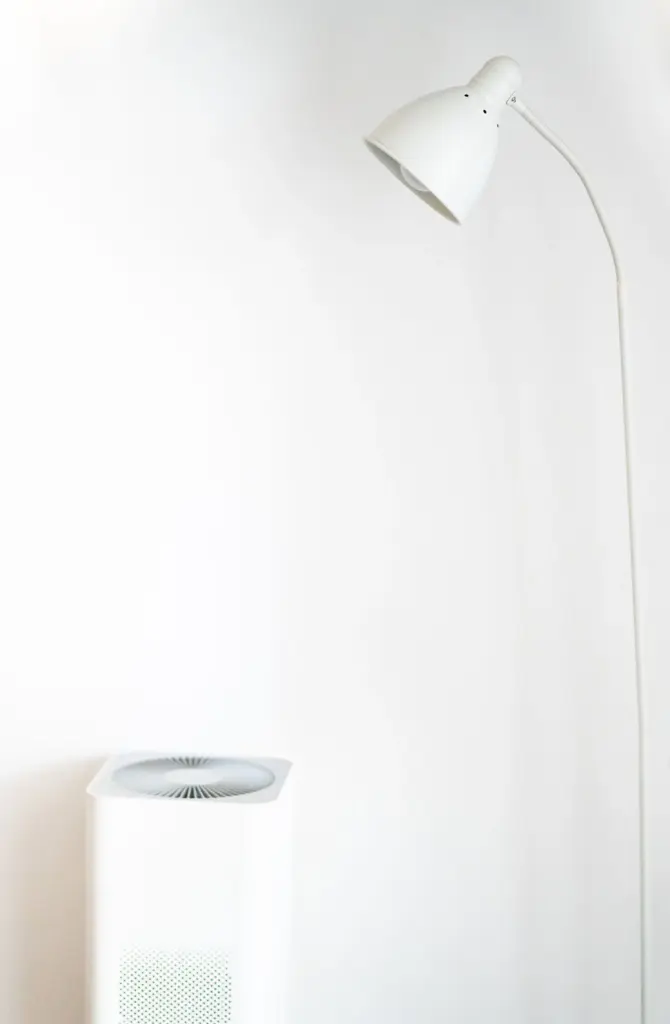
Choose a unit certified for particle removal and large enough for the room. Look for a smoke clean-air delivery rate, not only a square-foot claim created at the quietest fan speed.
A true HEPA filter is a strong simple choice. Replacement filters must be available and affordable. A cheap purifier with a rare $150 filter is not cheap.
Avoid ozone-producing devices. Ozone can irritate lungs. An ionizer or plasma feature should not replace real particle filtration.
Run the purifier on a high setting before smoke gets bad, then keep it running. Noise is a tradeoff. A large unit on medium is often easier to live with than a small unit screaming on high.
The verdict: buy capacity and replacement-filter access, not smart-home lights.
Set up one clean room properly
Choose a bedroom or living room that can stay cool enough with doors and windows closed. Remove obvious smoke sources. Put the purifier where air can enter and leave freely, not behind a sofa or curtain.
Run it before the room smells smoky. Particle levels are easier to keep down than to clear after hours of leakage. Use the highest tolerable fan speed. Close doors to unused rooms.
Check the filter without touching the dirty surface more than necessary. Follow the manufacturer for replacement and disposal. A filter may need earlier replacement after a severe smoke period even if the normal calendar says it has months left.
Do not spray fragrance to cover the smell. Fragrance adds chemicals and does not remove fine particles.
The verdict: one correctly sized, closed, cool room beats three weak machines scattered around the home.
Can you build a box-fan filter?
Health Canada says a do-it-yourself air cleaner can reduce particles when built and used correctly. It is not risk-free.
Use a newer fan with current safety features. Use a suitable furnace filter, commonly MERV 13 when the fan can move air through it. Follow a trusted design.
Health Canada warns not to leave a DIY unit unattended or run it while sleeping. Do not use an extension cord. Check the fan and plug for heat. Replace a dirty filter.
A commercial certified unit is the better long-term choice. A DIY filter can be a lower-cost emergency tool for an adult who can monitor it.
The verdict: useful with care, not a set-it-and-forget-it appliance.
Should you wear an N95 outside?
A well-fitted N95 or equivalent respirator can reduce the fine particles you breathe. It does not filter all gases in wildfire smoke. It does not protect your eyes.
The mask has to seal against the face. Facial hair across the seal reduces protection. A loose surgical mask is less effective for fine smoke particles.
People with breathing or heart conditions may find a respirator harder to tolerate. Ask a health professional if you are unsure. Stop activity and seek help if symptoms become severe.
The best mask does not make a long run safe on a bad-smoke day. Reduce the time outside and effort level too.
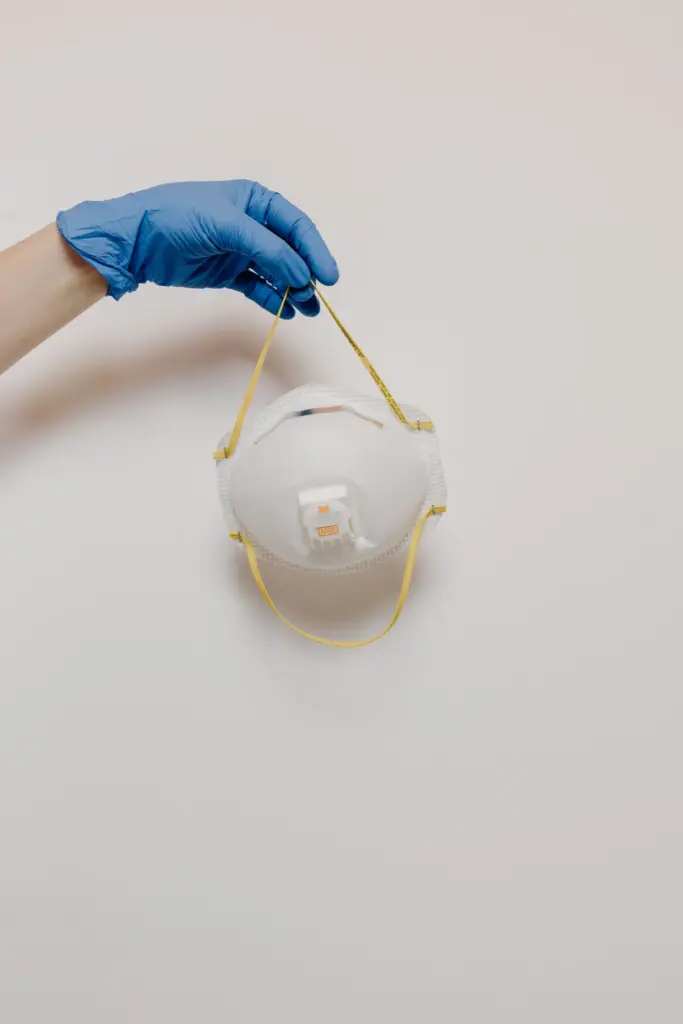
The verdict: wear a fitted respirator for necessary outdoor trips. Do not use it as permission for hard exercise.
Health Canada lists N95, KN95 and KF94 respirators as useful options when they fit well. Certification and fit matter more than the letters printed by an unknown seller. Buy from a reliable retailer and check the package.
Children need a model that fits their face. A loose adult mask can leave large gaps. Infants should not wear respirators. For a child with a health condition, ask their health professional for specific guidance.
Heat can be more dangerous than an open window
Smoke advice often says to close windows. That can make an apartment dangerously hot during a heat event.
Toronto's strategy says people should balance smoke and heat risk. If the home becomes too hot, go to an air-conditioned cleaner place. Use cooling equipment that does not pull smoky outdoor air inside when possible.
Portable air conditioners differ. A single-hose unit can create negative pressure and draw outside air through leaks. A properly installed two-hose or window unit may work differently. Follow the manufacturer and building rules.
Do not stay in an unsafe hot room to keep a perfect air reading. Older adults, babies and people with health conditions can overheat quickly.
The verdict: leave for a cooler filtered building when the room cannot stay safe.
Condo and apartment smoke needs a building plan
Multi-unit buildings share air through corridors, shafts, garages, windows and ventilation systems. One unit cannot control all of it.
Ask management these exact questions:
- What filter level does the central system use?
- When were the filters last changed?
- Can outdoor-air intake be adjusted safely during smoke?
- Which common room has the best filtration and cooling?
- How will residents be notified when settings change?
- What is the plan for residents who cannot keep a unit cool?
Do not block a required ventilation grille or fire-safety opening. A towel at a leaky suite door may reduce a small draft, but it must not create a tripping or egress hazard. Management should address serious corridor smoke entry.
Balcony smoking can add a local source on top of regional smoke. Record times and report repeated rule breaches through the building process rather than starting a hallway fight during an air event.
The verdict: a tower needs a written smoke response, not a memo telling everyone to close windows.
In a car, use recirculation for the smoky part of the trip
Close windows and set the ventilation to recirculate while driving through smoke. Run the air conditioning when needed for safe temperature. Replace the cabin filter according to the vehicle instructions, and ask whether a higher-efficiency compatible filter is available.
Recirculation is not meant for every condition forever. Follow the vehicle manual, watch for window fogging and use fresh air when outdoor conditions improve. Never sit in a running car in an enclosed garage.
Minimize stops and avoid busy outdoor pickup areas. A fitted respirator can help when leaving the car.
The verdict: keep the trip short and the cabin closed. The car is transport, not an overnight clean-air shelter.
Indoor Toronto plans that still feel like a day out
The first question is air, not entertainment. A building with strong filtration and closed doors is a better choice than a beautiful open-air market.
Good types of plans include:
- A film at TIFF Lightbox or another cinema.
- A long visit to the Royal Ontario Museum or Art Gallery of Ontario.
- A Toronto Public Library branch with enough seating.
- A community centre programme in a closed, cooled building.
- A quiet meal away from patios and open garage doors.
- An underground PATH walk during weekday business hours.
Call ahead when air is severe. Ask whether the venue is fully enclosed, air-conditioned and operating normally. An old building with open windows may be worse than home.
Our guide to six Toronto museums is older and needs current checks, but it can help choose the type of indoor day. Our temporary Ontario Science Centre review explains why that location may be too small for a full day.
The verdict: choose one large indoor place and stay. Repeated travel adds exposure.
How to check an indoor venue before buying a ticket
Call or message and ask:
- Is the activity fully indoors?
- Are exterior doors kept closed?
- Is the space air-conditioned?
- What filter level or portable cleaning is used?
- Has today's programme changed because of smoke?
- Can a ticket be moved if air conditions worsen?
- Is there an outdoor queue?
Front-line staff may not know a filter specification. That is useful information too. Choose a City cleaner-air space or another venue with a clear answer when someone in your group is at higher risk.
An indoor sports dome with large open doors is not the same as a sealed museum. A patio with a roof is still outdoors.
The verdict: "indoors" is a building description, not proof of clean air.
What plans should you cancel?
Cancel or postpone a long run, outdoor sports, a patio meal, a beach day, a long bike ride or a festival when health guidance says to reduce strenuous outdoor activity.
An outdoor concert is a harder call because the ticket may be expensive. Check the organizer's policy and official health alert. Do not expect the event to cancel only because the air feels bad to you.
If you attend, reduce time outside, wear a fitted respirator, skip smoking and leave when symptoms start. People at higher risk should be more cautious and follow medical advice.
The verdict: the sunk ticket cost does not make the air safer.
What event organizers should publish
A Toronto festival, league or camp should not wait until guests are standing at the gate.
A useful smoke plan names:
- The AQHI source and decision time.
- The threshold for reducing, moving, postponing or cancelling activity.
- Separate steps for higher-risk participants and staff.
- The refund, transfer or credit policy.
- Where people can wait in filtered indoor air.
- Who has authority to make the final call.
- How workers will receive breaks, respirators and medical help.
Outdoor work has its own employer responsibilities. Ontario's guidance for working outdoors covers environmental hazards and employer planning. A worker should use the workplace reporting process when smoke controls are missing or symptoms appear.
The verdict: a plan that starts with "the event is rain or shine" is not a smoke plan.
Child care, camps and schools need a lower-drama plan
Toronto Public Health provides wildfire-smoke guidance for child-care centres. Operators should monitor alerts, reduce exposure, consider ventilation and filtration, watch symptoms and communicate changes.
Parents should ask where children will play, whether doors stay open, how vigorous exercise changes and what happens if the building overheats. Send required rescue medication and make sure instructions are current.
Do not expect a young child to judge breathing symptoms or maintain a respirator seal for hours. Reducing the activity and exposure is more dependable.
The verdict: move active play indoors early and keep the room cool.
Pets need protection too
Dogs and other animals also breathe smoke. Keep walks short for bathroom needs. Avoid running and long play. Use indoor enrichment instead.
Watch for coughing, unusual breathing, eye irritation, weakness or reduced appetite. Ask a veterinarian if symptoms appear or if the animal has heart or lung disease.
Do not put a human N95 on a pet unless a veterinarian gives specific advice and equipment. A poor fit can cause stress and does not create a proper seal.
The verdict: short walk, low effort, back inside.
After the smoke clears
Check the official conditions before opening every window. When outdoor air is clearly better, air out the home if temperature and security allow.
Wipe hard surfaces with a damp cloth. Wash bedding that smells smoky. Follow the purifier and HVAC instructions for filter replacement. Avoid shaking a dirty filter indoors.
Smoke odour can remain after particle levels fall. Odour alone does not provide a precise air-quality measurement. If symptoms continue in the home, inspect for an indoor source and speak with a health professional or qualified building expert as appropriate.
Rest before restarting hard exercise. A clear sky does not require a personal fitness test that afternoon.
The verdict: reset the room, replace loaded filters and return to activity gradually.
How to prepare before the next smoke day
Smoke events are easier when supplies are ready.
Keep:
- Several well-fitting respirators in adult and appropriate youth sizes.
- A portable air cleaner and one spare filter.
- A clean central HVAC filter if your system uses one.
- Required medication and a written refill plan.
- A battery pack and charging cable.
- The address of the nearest cleaner-air space.
- Indoor activities for children.
- A thermometer for rooms that overheat.
Check filters before the sky changes. Popular sizes can sell out during an event.
The final verdict: prepare once, then make the boring safe choice when smoke arrives.
Frequently asked questions
What AQHI level is dangerous in Toronto?
Risk rises as the AQHI number rises, with 10+ classed as very high risk. Follow the current official advice for your risk group and reduce activity sooner if you have symptoms.
Should I close my windows during wildfire smoke?
Close them when outdoor air is worse, if the indoor temperature stays safe. If the home overheats, move to a cooled cleaner-air place rather than trading smoke risk for heat risk.
Does an N95 protect against wildfire smoke?
A well-fitted N95 can reduce fine smoke particles. It does not remove all gases or protect eyes, and it does not make hard outdoor exercise safe.
Are Toronto malls cleaner-air spaces?
Not automatically. Filtration and outdoor-air settings vary. The City publishes specific civic cleaner-air spaces with MERV 13 filtration.
Can I run an air purifier with the windows open?
It will be less effective when smoky outdoor air keeps entering. Close the room when safe and use a purifier sized for that space.
Is a box-fan filter safe overnight?
Health Canada says not to leave a DIY air cleaner unattended or run it while sleeping. Use a certified commercial unit for routine overnight use.
Can I exercise indoors during a smoke event?
Yes, when the building air is cleaner and you feel well. Reduce intensity or stop if you develop cough, wheeze, chest discomfort or unusual shortness of breath.
When should smoke symptoms get medical help?
Contact a health professional for concerning or persistent symptoms. Call 911 for severe breathing trouble, chest pain, confusion, collapse or another emergency.