


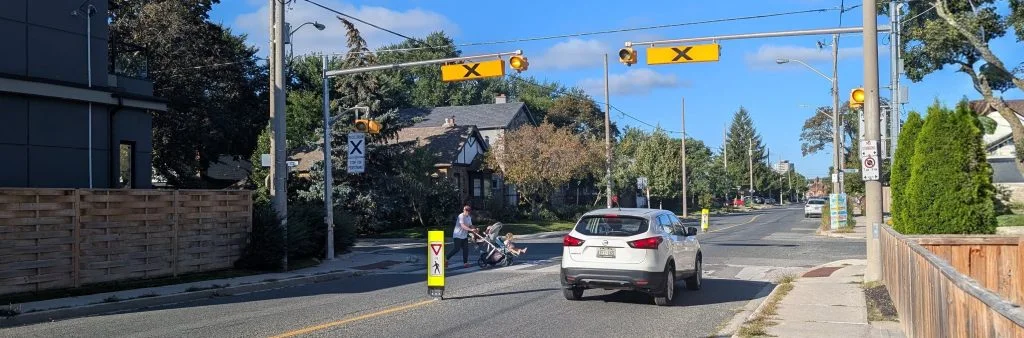
Pointing tells a driver that you intend to cross. It is part of Ontario's pedestrian-crossover guidance, not just an old Toronto habit.
The history is older than many people remember. A 2006 City staff report says Metropolitan Toronto installed its first pedestrian crossover in 1958. Ontario added crossover legislation in 1962.
The important limit is that pointing isn't a shield. Use the marked crossing, follow the signal where one applies and wait for vehicles to stop. Don't assume a raised hand makes a driver see you.
What kind of crossing are we talking about?
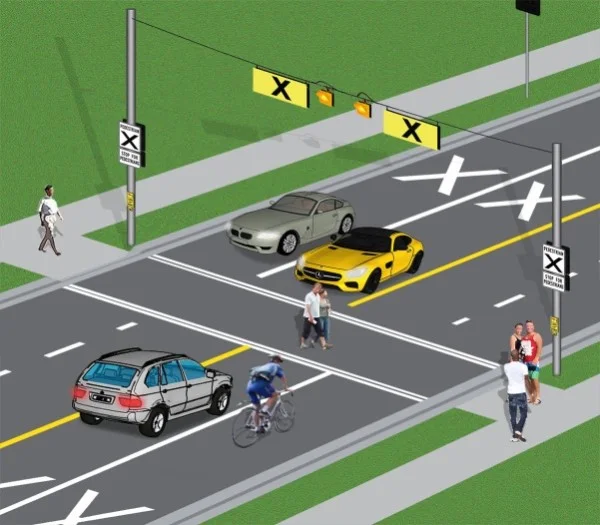
| Crossing | What to look for | What to do |
|---|---|---|
| Pedestrian crossover | Designated signs and markings, sometimes flashing lights | Indicate your intent, check the traffic and cross when vehicles have stopped |
| Signalized crosswalk | Traffic lights and pedestrian signals | Follow the pedestrian signal and check turning traffic |
| School crossing with a guard | A crossing guard controlling the crossing | Follow the guard's instructions |
| An ordinary unmarked stretch of road | No designated crossover | Don't treat pointing as creating a crossing |
The words crosswalk and crossover are often used loosely. The rules depend on the actual crossing.
The local history starts in 1958

The City's April 2006 pedestrian-crossover report records the first Metropolitan Toronto installation in 1958 and Ontario legislation in 1962.
It also describes later efforts to make crossover designs more consistent and to improve public understanding.
That supports the older residents' memory of a local crossing system. It does not establish the first date of every sign slogan or the exact wording used at each location.
We haven't verified a precise first date for the remembered “point” signs. As of October 11, confidence in a particular 1970s or 1980s origin claim is low without an archive record of the sign itself.
The useful historical distinction is that the crossover system predates those decades.
Toronto is testing clearer crossover markings
The City is testing enhanced signs and pavement markings at selected crossovers. Treatments include flexible in-road signs, zig-zag lines and triangular yield markings often called shark's teeth.
Mortimer Avenue at Dewhurst Boulevard is one listed location. The photograph at the top of this guide shows that crossing in the City's current material. Other pilot sites include Lansdowne south of Bloor and Guildwood Parkway west of Schubert Drive.
The programme tests whether clearer road cues improve driver compliance. It does not establish that every treatment has already worked. The City says it will share findings when they are available.
That is a more useful response to poor yielding than treating a pedestrian's arm gesture as the whole safety system. Watch the actual traffic, and use the marked crossing.
Why the new markings need a proper test
The City's pilot page reports 180 collisions from 2014 through 2024 in which a driver struck a person crossing at a pedestrian crossover. About 12% of the pedestrians involved needed hospital care.
It also cites a 2019 study at selected crossovers with average driver yielding of about 75%. That is a study of selected locations. It isn't a current citywide rate, and it doesn't say that exactly one in four drivers will fail to stop at your crossing today.
The new pilot uses control sites with similar conditions. Some locations receive different combinations of flexible signs, zig-zags and triangular yield markings. This lets the City compare the treatments. It also means you shouldn't expect the same package at every listed crossing.
Our verdict is that clearer signs deserve testing, but the success claim needs results. The October 12 check found the pilot description, not a completed before-and-after safety evaluation.
If a crossover has damaged equipment, use the City's 311 crossover service-request route. Give the exact street and nearest intersection. Don't treat an extra gesture as a repair for a broken crossing device.
Is pointing still in the official advice?
Yes. Ontario's pedestrian-safety page advises pedestrians to indicate that they are waiting to cross and to wait until the driver has fully stopped.
The MTO crossover guidance also describes pointing across the road before entering a crossover.
That means it isn't only a nostalgic gesture. It is current provincial guidance.
But guidance for pedestrians and a driver's duty are separate matters. A person shouldn't have to perform an exaggerated gesture to deserve careful driving.
Use a clear signal if you can. Keep watching for an actual stop.
What drivers and cyclists have to do
Ontario's crossover and school-crossing rules say drivers, including cyclists, must stop and yield the whole width of the roadway at the specified crossings.
They must wait until the pedestrian or crossing guard has cleared the roadway before proceeding where those rules apply.
This isn't an invitation to squeeze behind a person who is halfway across. A cyclist is part of the rule too.
Choose patience at the crossing. A few saved seconds are a poor reason to move through a person's path.
Flashing lights aren't the same as a pedestrian walk signal
A crossover with flashing lights warns traffic about the crossing. It isn't the same equipment or rule as an intersection's walk signal.
If a crossing has an activation button, use it as directed by the signs. Then wait for traffic to stop. Pressing a button doesn't instantly make the road clear.
At a signalized intersection, follow the MTO pedestrian-signal guidance. A flashing or steady hand means don't begin crossing.
If you are already crossing when the signal changes, keep moving toward the far sidewalk as the guidance directs. Don't reverse unpredictably in the roadway.
Choose the instructions for the crossing in front of you. Don't apply a crossover habit to every traffic-light intersection.
Is it unique to Toronto?
No. The current advice comes from Ontario, and crossover rules apply beyond Toronto.
The claim that no other city tells pedestrians to indicate their intention isn't established by our research. We won't turn that into a quirky local fact.
Toronto's early crossover history makes the habit locally meaningful. That is interesting enough without pretending it exists nowhere else.
Use the same care when visiting another city. Look at the crossing design and local instructions rather than expecting every street to work like Toronto.
Access and different ways to communicate
Not everyone can raise an arm or make eye contact. A pedestrian can have a mobility, vision or other access need.
That is another reason not to treat the gesture as a test someone must pass before drivers stop. Road design, visibility and driver behaviour matter for all users.
If you need a crossing with signals or a more predictable route, plan for that. The shortest walking route isn't always the best accessible route.
Don't blame someone for being unable to use a particular gesture. Choose a street design and behaviour that make the crossing usable.
The rules changed. An old Toronto habit is not an old legal rule
The timeline worth keeping straight
| Period | Established point | What it means today |
|---|---|---|
| 1958 | Metro Toronto's first pedestrian crossover, recorded in the City's later report | The system is older than many memories of pointing signs |
| 1962 | Ontario introduced crossover legislation, according to that report | This became a provincial crossing system |
| January 2016 | Ontario's full-roadway yielding rule took effect at the specified crossings | Older half-roadway explanations are not the current rule |
| 2026 pilot | Toronto is testing additional signs and markings at 16 listed sites | Different treatments are being evaluated; results are not yet established |
The Hamilton Police pedestrian-safety material records the January 2016 change. Current Ontario crossover rules should govern today's decision, rather than an archived passage explaining an older rule.
Drivers and cyclists: three details that matter
At the specified pedestrian crossovers and school crossings, wait until the pedestrian and crossing guard have cleared the roadway as the provincial rule requires. Don't resume because the person has passed your lane.
The MTO crossover guidance also says not to pass another vehicle within 30 metres of a pedestrian crossover. A stopped vehicle may be hiding the person crossing. The problem is not solved by checking only the lane beside you.
Ontario lists a fine of up to $1,000 and four demerit points for failing to yield at the applicable crossings. It also describes doubled fines in marked Community Safety Zones. These are published penalty rules, not a prediction of the result in a particular case.
A signalized intersection is different
The full-roadway crossover rule should not be copied onto every ordinary traffic-light crosswalk. At an intersection, the pedestrian signal and the rules for turning traffic matter. A crossover's flashing warning lights are different equipment from a walk signal.
For a person walking, wait for a proper opportunity to begin and check the turning traffic. For a driver turning, watch the crossing rather than assuming a green light means the path is clear. Pointing does not replace those rules.
This distinction is useful because the same person may encounter both crossing types within one block. Read the equipment and signs in front of you, not the label someone casually used for it.
All 16 pilot sites, without assuming identical markings
The City's pilot page lists these sites. The two-lane and four-lane groups have different settings, and locations do not necessarily receive every treatment.
| Two-lane sites | Four-lane sites |
|---|---|
| Guildwood Parkway west of Schubert Drive | Carlaw Avenue north of Queen Street East |
| Lansdowne Avenue south of Bloor Street West | Consumers Road west of Hallcrown Place |
| La Rose Avenue east of Griggsden Avenue | The East Mall north of Robinglade Drive |
| Wellesworth Drive south of Dixfield Drive | Dundas Street north of Glenlake Avenue |
| Guildwood Parkway at Chancery Lane | Weston Road at Coulter Avenue |
| Warden Avenue at Freeman Street | Lansdowne Avenue at Brandon Avenue |
| Mortimer Avenue at Dewhurst Boulevard North | Kingston Road at Manderley Drive |
| La Rose Avenue at Arcade Avenue | Lansdowne Avenue at Paton Avenue |
The trial includes comparable control sites. Its purpose is to evaluate treatments individually and together. A new flexible sign or zig-zag line therefore signals a test, not a proven reduction in injuries at that exact location.
What should the evaluation answer?
The first question is whether more drivers yield. The next is whether yielding remains better over time and in different conditions. A driver slowing without stopping may look more cautious while still failing the practical crossing test.
The study should also distinguish two-lane and four-lane roads. A stopped vehicle obscuring another lane is a different problem from one vehicle approaching on a two-lane street. It should record the treatment installed at each site before comparing the outcomes.
For pedestrians, the practical advice stays consistent during the test: make your intention clear where you can, activate equipment as directed, and watch for a full stop. New markings don't make an approaching vehicle physically stop.
What to report when the crossing itself is the problem
Use Toronto's crossover information and 311 route for damaged equipment or a location needing attention. Give the exact crossing, the direction of approach and the visible problem.
“The flashing unit is not working on the west approach at this intersection” is more useful than “drivers are bad here.” For a recurring visibility issue, name the obstruction and when it occurs. A person should not have to compensate for broken equipment with a larger arm gesture.
The older habit is a useful communication tool. The stronger system combines clear crossing design, functioning equipment and drivers following the current rule. Keep all three in the story.
Where to research an old crossing or street sign
For a particular corner, start with the street name, nearest cross street and a rough decade. Search for photographs as well as words such as “pedestrian crossover,” “crosswalk” and “point.” An image date is evidence of what was there then, rather than proof of today's rule.
The City of Toronto Archives at 255 Spadina Road is the best first source for city-government records, old street photographs, maps and plans. Its website links to the database and appointment information. Identify a file or photograph before booking a research visit.
Toronto Reference Library, at 789 Yonge Street, is another place for reference help and local-history research. Its current notice warns of intermittent building and floor closures, reduced seating and services during renovations from August into October 2026. Check the branch notice before going.
For provincial records, the Archives of Ontario is at 134 Ian Macdonald Boulevard. It requires a free researcher account to request records to the Reading Room. Choose it when the question is about provincial legislation or records, rather than assuming it holds a photograph of every Toronto corner.
Use the city archive for the sign and intersection. Use provincial records for the law. Use current crossing signs and official road guidance for the walk you're making today.
Frequently asked questions
Why do people point before crossing in Toronto?
The gesture indicates an intention to cross at a pedestrian crossover. It helps communication but doesn't guarantee a driver has seen you.
Is pointing still recommended?
Ontario's current pedestrian and crossover guidance includes indicating your intention. Wait for vehicles to stop before entering the road.
Is the habit only found in Toronto?
No. The current advice and crossover rules are provincial. The claim that no other city uses it isn't supported here.
When did Toronto introduce pedestrian crossovers?
A 2006 City report says Metropolitan Toronto installed its first one in 1958. That doesn't establish the first date of every pointing sign.
Do cyclists have to stop too?
Yes. Ontario includes cyclists in the stopping and yielding rules for the specified crossovers and school crossings.
Can I start crossing when the hand signal flashes?
At a signalized crossing, the MTO says not to begin on a flashing or steady hand. Follow the signal and check traffic.
Does a pedestrian lose protection if they can't point?
Don't treat a gesture as a condition for careful driving. Different access needs affect how people communicate. For legal questions about a specific event, get specific guidance.
For more walking choices, see our Toronto neighbourhood and outdoor guides. Keep the old habit if it helps you signal clearly. Keep the more important habit too: wait for a real stop.
Related Toronto guides: How to Use Bike Share Toronto Without Surprise Charges.