

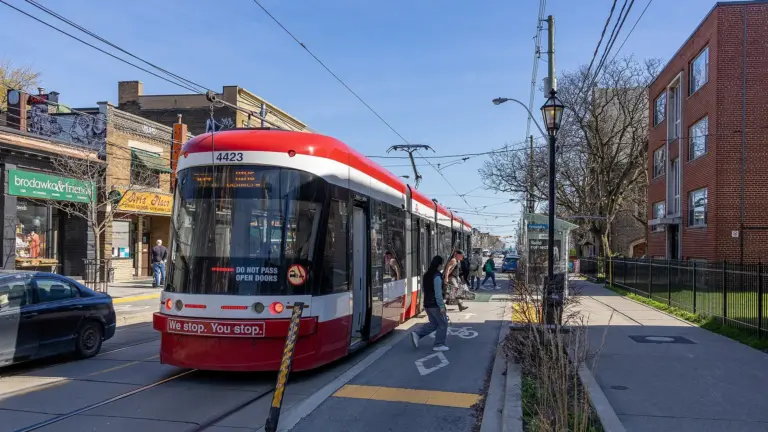

No camera is automatically mailing tickets for passing a Toronto streetcar yet. The TTC started a nine-month camera pilot on July 20, 2026, but the test collects evidence and checks the technology. It does not issue tickets during the pilot.
The driving rule already exists. When a streetcar stops in a shared traffic lane and opens its doors, road users behind it must stop at least two metres from the rear doors and stay stopped until passengers are safely on the sidewalk and the doors close. The rule applies to drivers, motorcyclists and people using bikes, e-bikes or scooters.
Our verdict: automated enforcement should become permanent if the pilot proves accurate. Between 2014 and 2024, 141 people were struck by vehicles while boarding or leaving streetcars. Education alone has had enough time. The main weakness is that riders still face danger during a test that records violations without issuing consequences.
What is happening now?
| Question | Answer as of September 1, 2026 |
|---|---|
| Are camera tickets being mailed? | No |
| When did the pilot start? | July 20, 2026 |
| How long is the test? | Nine months |
| How many streetcars have test equipment? | Four |
| Which routes are involved? | 501 Queen, 504 King, 505 Dundas, 506 Carlton and 511 Bathurst |
| What is the current offence penalty? | Up to $183.25 plus three demerit points, according to the TTC |
| Who must stop? | Cars, vans, motorcycles, mopeds, bikes, e-bikes and scooters in the passing lane beside an open-door curbside stop |
The route list does not mean every vehicle on those routes has a camera. The TTC placed equipment on four streetcars that may operate on the five mixed-traffic routes.
The rule in plain language
When a streetcar stops and opens doors into a live traffic lane, stop behind it. Leave at least two metres from the rear door. Do not move again until every passenger has reached the sidewalk and the doors are closed.
Do not squeeze past slowly. Do not assume a person has seen you. Do not use a bike lane or gap on the right to pass the doors.
The person stepping out of the streetcar may be a child, use a cane or be looking toward the curb rather than back at traffic. The vehicle is large enough to hide them until the last moment.
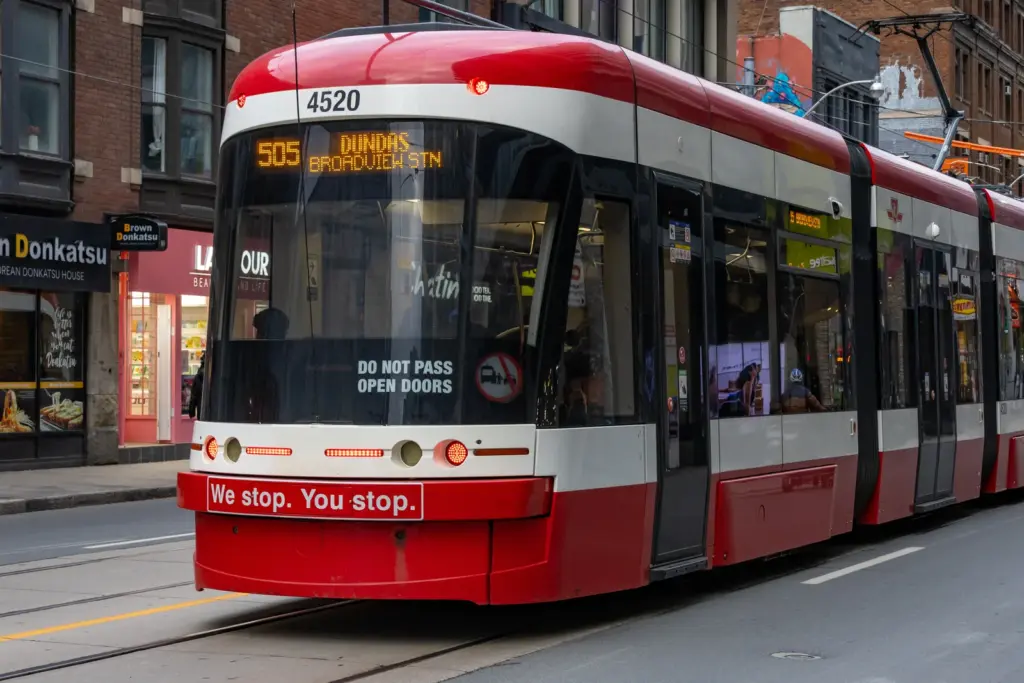

When can you pass a stopped streetcar?
You can pass when the doors remain closed and no passenger is entering or leaving through the traffic lane, provided every other traffic rule allows it.
If the stop has a raised island or protected platform that separates passengers from traffic, drivers follow the signs and lane design. You generally continue in your lane because passengers are not stepping into it.
When uncertain, stop. Losing a few seconds is better than guessing beside an opening door.
What if the streetcar is stopped but the doors are closed?
This is the situation that causes the most confusion. A streetcar may wait at a red light, pause before opening or stop for another operational reason.
The legal boarding danger begins when the doors open and passengers use the road. A driver may still face another reason to stop, including a red light, a sign, traffic or a pedestrian.
Do not accelerate hard beside a stopped streetcar just because the doors have not opened yet. The operator may be preparing to serve the stop.
Would a warning light help?
Streetcars already use lights and door movement, but several drivers say the change from stopped to boarding can feel sudden. A clear advance warning could reduce genuine mistakes.
That does not excuse passing open doors. The rule is about the actual danger, not whether the driver liked the warning design.
Our preference is a short, unmistakable exterior warning phase before doors unlock, combined with cameras and public signs. The warning should support enforcement, not replace it.
How the camera pilot works
The test equipment comes from Gatekeeper Systems, a British Columbia company. Cameras record the area beside the doors. The pilot measures how often illegal passing occurs and whether the technology can identify the event reliably.
An enforcement system needs more than a clear video. It must identify the vehicle, time, location, door state and legal lane conditions. It also needs a lawful process for reviewing evidence and serving a charge.
That is why the pilot is not yet an automatic ticket programme.
Which routes are included?
501 Queen
The long Queen corridor includes many curbside stops where passengers enter from the road. Busy retail blocks and constant turning traffic make violations especially frightening.
504 King
The King Street Transit Priority Corridor changes traffic patterns in the core, but mixed-traffic sections remain. Drivers who rarely use downtown need to understand that a streetcar door is not an invitation to slip past.
505 Dundas
Dundas has narrow sections, busy intersections and curbside boarding. Visibility can be poor around parked or turning vehicles.
506 Carlton
Carlton and College carry a long route through dense neighbourhoods, schools and hospitals. A rider may need more time to cross the lane.
511 Bathurst
Bathurst now includes different lane treatments by section. The rule at a curbside shared stop is not the same as movement beside a protected platform. Read the street in front of you.
Why the pilot does not cover every route
The test focuses on mixed-traffic routes where doors open beside a lane used by other road users. Routes with more separated platforms have a different risk pattern.
Four equipped vehicles also provide a manageable technology sample. It is not enough to measure every intersection or time of day.
If the pilot moves to enforcement, the TTC and Province should publish where cameras operate, how evidence is reviewed and how errors can be challenged.
The injury number matters
The TTC reports 141 people struck by vehicles while boarding or exiting streetcars between 2014 and 2024.
That is not a harmless etiquette problem. A rider is following the transit system's normal boarding process and enters a lane the law says should be stopped.
The correct goal is zero. Even a low average per year is unacceptable because the solution is clear and the harm can be severe.
What the fine means
The TTC says the existing offence can carry a total fine of up to $183.25 and three demerit points. A police officer can enforce the law now. The pilot itself does not issue that ticket.
Do not rely on the amount remaining fixed. Fines, fees and automated-enforcement authority can change. Recheck the Highway Traffic Act and TTC page before publication.
The important point is that the act is already illegal. The camera debate is about catching it more consistently.
.jpg)
Could the owner receive a ticket instead of the driver?
Automated red-light and speed systems often use owner liability because a camera may not identify who was driving. Streetcar-door enforcement would need a clear legal framework.
The TTC pilot announcement did not say that owner tickets were already authorized or being sent. Comments predicting the final legal process are speculation.
If a permanent system is proposed, the City and Province must explain whether charges go to the driver or registered owner, whether demerit points apply and how a review works.
What cyclists and scooter riders need to know
The stop rule is not only for cars. A bicycle or scooter can seriously injure a person stepping from a streetcar.
Stop behind the open doors. Do not thread between passengers. A painted bike lane does not cancel the duty to stop when it passes through the boarding area.
At a raised protected stop, follow the signs, signals and yield markings. Slow enough to stop for anyone crossing the bike path.
What streetcar passengers should do
Look toward traffic before stepping down, even though you have the right of way. The law cannot stop a vehicle that is already ignoring it.
Hold a child's hand. Give a mobility device enough time. Do not stand in the lane to argue with a driver.
If a vehicle passes dangerously, note the route, streetcar number, direction, stop, time, plate and description from a safe place. Report it to police when appropriate and to the TTC for pilot data. Call 911 for a collision or immediate danger.
What drivers should do near any streetcar stop
- Watch the streetcar's speed and stop request signs.
- Do not race to get beside it before a stop.
- When it stops, cover the brake and expect the doors.
- Stop at least two metres behind the rear door when doors open into your lane.
- Scan for the last passenger, including someone moving slowly.
- Wait until the doors close and the lane is clear.
- Accelerate gently.
This costs seconds. Passing can cost a life.
What would make the programme better?
Permanent cameras after a transparent accuracy test
Publish false-positive and missed-event rates. Use trained human review before any charge.
Better warning design
Give drivers a clear exterior signal just before doors open. Keep the stop rule simple.
More raised stops
Raised islands or platforms separate passengers from the live lane and improve accessible boarding. They need careful bike-path design.
Street design that prevents passing
On the busiest blocks, a curb extension or protected layout is stronger than a sign.
Public reporting
Publish violations by route and time, collisions and outcomes. Do not announce a pilot and hide the result.
The honest conclusion
Toronto does not need another decade of polite reminders. The open-door passing rule is easy. The danger is obvious. Cameras should be used if they can record the offence accurately and a fair review process exists.
Until then, the pilot is only watching.
Keep exploring Toronto
- The Toronto driving rules visitors and new drivers need
- Can you park in front of your own driveway in Toronto?
- Your Ontario tow-truck rights before you pay
Official pages to check
Prices, rules, hours and project details can change. Check these primary pages before you spend money or make a special trip:
Frequently asked questions
Are TTC streetcar cameras issuing tickets now?
No. The nine-month pilot that began July 20, 2026 is testing technology and measuring illegal passing. It does not issue tickets during the test.
How far behind open streetcar doors must a driver stop?
Stop at least two metres behind the rear door when passengers are boarding or leaving into the traffic lane.
Can a cyclist pass open streetcar doors?
No. The stop rule applies to bicycles, e-bikes and scooters as well as motor vehicles when the boarding area crosses their lane.
What is the fine for passing a stopped streetcar?
The TTC says the offence carries a fine of up to $183.25 plus three demerit points. Recheck the current law because penalties can change.
Which routes have the camera pilot?
Four equipped streetcars operate across 501 Queen, 504 King, 505 Dundas, 506 Carlton and 511 Bathurst during the pilot.
Can I pass if the streetcar is stopped with its doors closed?
Only when every other traffic rule allows it and no passenger is using the lane. Slow down and expect the doors to open if the streetcar is at a stop.
Why not build raised platforms at every stop?
Raised stops are safer and more accessible, but they need road space, drainage, bike-path design and construction money. Cameras can address behaviour while physical upgrades continue.