

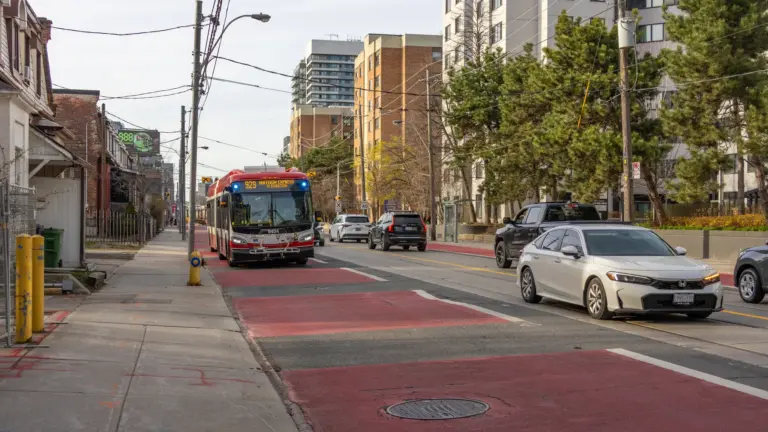

Toronto's red transit lanes can make buses and streetcars faster. Paint alone cannot. The lane needs to be continuous, clear of parked cars, supported by turn rules and signals, and enforced often enough that drivers stop treating it as a shortcut.
Our verdict: RapidTO Eglinton East is the strongest existing proof because it gives Scarborough riders a long 8.5-kilometre priority corridor. Dufferin is the most useful new test. Bathurst south of Bloor is promising, but the weakened bus treatment north of the station shows how quickly political compromise can hollow out a route.
The main deal-breaker is enforcement. A red lane full of illegally stopped vehicles is expensive decoration.
The short answer
| Question | Answer |
|---|---|
| Who can use a red priority bus lane? | TTC and other authorized buses, Wheel-Trans, school buses, emergency vehicles and bicycles where signed |
| Can a driver enter to turn? | Yes where the paint is dashed, generally up to 45 metres before the turn |
| Can a driver stop for pickup? | No, unless a signed loading area specifically allows it at that time |
| What is the lane-misuse fine? | City guidance lists $110 plus three demerit points for improper lane use |
| What is the stopping fine? | City guidance lists $170 |
| Are every red lane and rule identical? | No. Follow the signs and markings on that corridor |
| Does red paint guarantee faster service? | No. Signals, turns, stops, enforcement and route management also matter |
How to drive beside a red bus lane
Solid red section
Stay out. A solid white line and red surface mark the reserved lane.
Do not use it to pass a queue, make a delivery or wait with hazard lights.
Dashed red section
Enter where the lane becomes dashed to reach a driveway or make a legal turn. Toronto's guide allows a driver to merge into the bus lane for no more than 45 metres before leaving it.
Check for a bus, streetcar, cyclist or pedestrian before crossing.
Passing a left-turning vehicle
City guidance permits limited use of a priority lane, up to 45 metres, to pass a vehicle waiting to turn left where the movement is legal. Follow signs because some intersections ban the turn or movement.
Stopping and loading
Do not stop in the lane. Dufferin includes time-of-day loading zones outside the reserved travel space. Use the signed zone at the correct hour.
Hazard lights mean "my vehicle is a hazard." They do not create a delivery exemption.
.jpg)
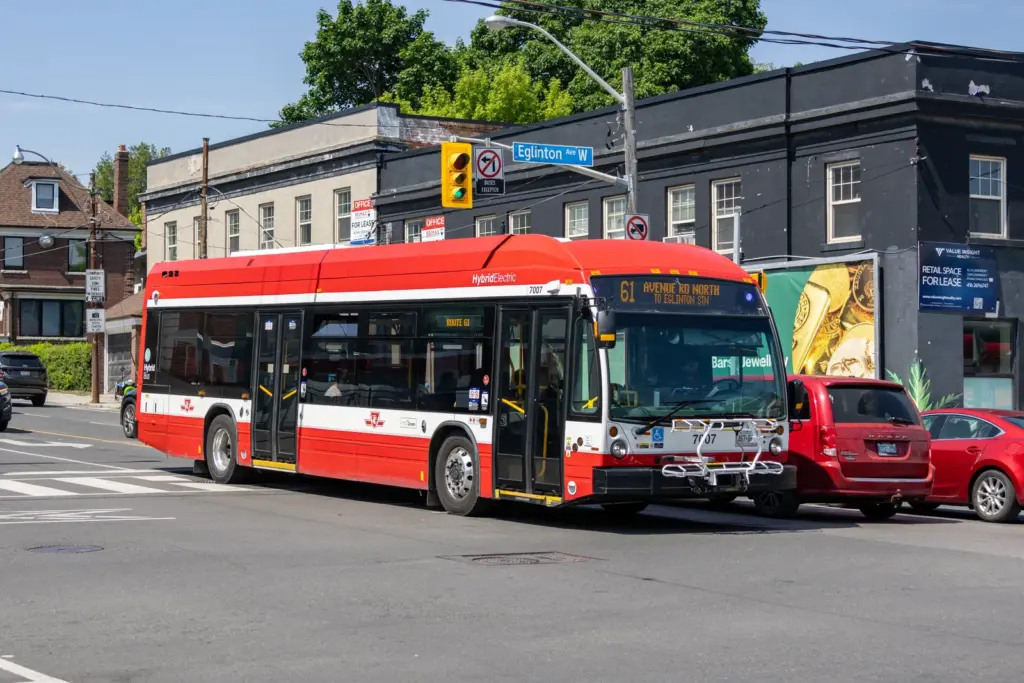
RapidTO Eglinton East
Toronto opened its first major RapidTO corridor in November 2020. It runs about 8.5 kilometres along Eglinton Avenue East, Kingston Road and Morningside Avenue from Brimley Road to the University of Toronto Scarborough area.
This is where the program makes the most sense. Many riders travel long distances on buses. Wide roads provide room. The corridor connects neighbourhoods that waited too long for higher-order transit.
The City publishes a monitoring dashboard. That is essential because speed in one direction at one hour is not enough. Judge travel time, reliability, safety, ridership and effects on nearby streets.
Our decision: keep it, enforce it and extend useful connections. Do not remove it because one driver lost a general lane.
RapidTO Dufferin
The City and TTC completed priority bus lanes from Dufferin Station to King Street West in May 2026. The design gives one red bus lane and one general lane in each direction, removes on-street parking and adds loading windows, signal changes and turn restrictions.
This is a hard corridor and a fair test. Dufferin carries heavy bus demand through dense neighbourhoods, retail streets and major event areas.
The project stops at King rather than continuing through every crowded section. It also does not solve bus bunching by itself.
Our decision: use the two-year public monitoring to improve the lane, not as an excuse to wait two years before towing blockers.
RapidTO Bathurst
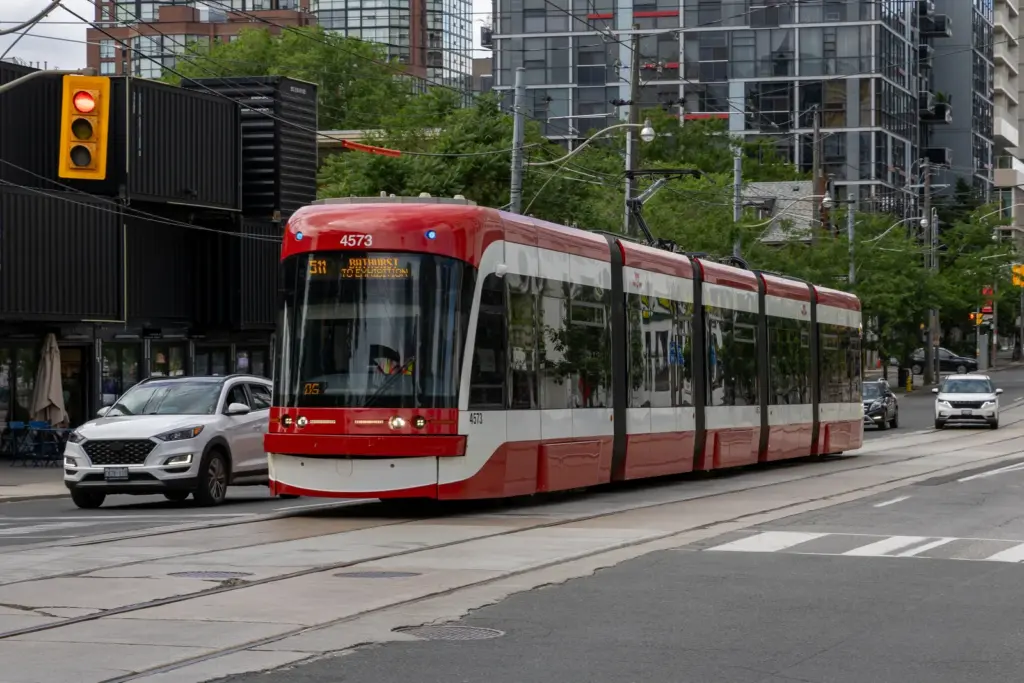
The 3.4-kilometre priority streetcar section from Bathurst Station to Lake Shore Boulevard was completed in May 2026. Red centre lanes, parking removal, turn restrictions and signal changes support the 511 streetcar.
North of Bathurst Station, the 7 Bathurst bus did not receive the full red-lane treatment. The City instead installed time-based stopping restrictions, turn restrictions and signal changes between Eglinton and the station.
That is the weak compromise. About 35,000 people use the 7 Bathurst bus daily according to a 2026 TTC Board item. Those riders still share general traffic.
Our decision: measure the interim rules quickly. If bus speed and reliability remain poor, install stronger continuous priority.
King Street is the earlier lesson
The King Street Transit Priority Corridor showed that turn restrictions, through-traffic limits, stop design and enforcement can transform streetcar movement without a full concrete separation.
It also showed that rules must be obvious. Drivers who misunderstand the required turn can block the route and receive a ticket.
King is not identical to Dufferin or Eglinton. The lesson is the package: lane rule, intersection rule, curb management and enforcement must work together.
The 20 corridors Toronto says are priorities
The Surface Transit Network Plan identifies 20 roadways for corridor-specific study by 2032. A study does not guarantee a red lane. The right treatment may be signal priority, queue jumps, turn changes, stop moves or full reserved lanes.
This map shows an approximate area. Open the full map.
- Bathurst Street North
- College, Carlton and Gerrard Street East
- Don Mills Road
- Dufferin Street South
- Dundas Street
- Eglinton Avenue East, Kingston Road and Morningside Avenue
- Finch Avenue East
- Jane Street
- Keele Street
- King Street
- Lawrence Avenue East
- Lawrence Avenue West
- McCowan Road
- Queen Street
- Sheppard Avenue East
- Sheppard Avenue West
- Steeles Avenue West
- Victoria Park Avenue
- Weston Road
- Wilson Avenue
Our top next priorities are Jane, Lawrence West, Finch East, Don Mills and Victoria Park because long bus trips and high ridership make reliability gains valuable. Queen and College-Carlton-Gerrard need a streetcar-specific plan that tackles parked cars and turns, not only red paint.
Why buses bunch even with a lane
Suppose the first bus meets a crowd. Boarding takes longer. The bus behind meets fewer people and catches up. Soon two buses arrive together, followed by a gap.
A bus lane reduces random traffic delay but does not fix uneven dispatching, long boarding, operator relief, terminal congestion or service gaps.
The TTC needs active headway management. Hold or turn buses when needed, dispatch them evenly and give riders accurate live information.
Do not blame a bus lane for a schedule-management problem it was never designed to solve.
Signals can matter more than paint
A bus that reaches a red light every block is not rapid. Transit signal priority can extend green, shorten red or give a queue-jump movement.
Priority should respond to whether the vehicle is late and how many riders are aboard. A blanket green extension can disrupt crossing streets without improving reliability.
Publish signal-priority performance alongside travel times. Invisible technology should still face public measurement.
Stop spacing is an honest trade-off
Stops on every short block make walking easy but slow everyone onboard. Removing too many stops creates long or difficult walks for older riders, disabled riders and people carrying groceries.
Use actual boarding data, slopes, crossings, hospitals, schools and transfer points. A stop with low use may still be essential because no safe alternative exists.
Our rule: consolidate redundant stops only when the new walking route is safe and accessible.
Bikes in red lanes
Toronto permits bicycles in the signed priority bus lanes described by the program. That does not mean the lane is a comfortable protected cycle track.
A person cycling shares space with large vehicles and may face buses pulling into stops. Drivers turning across the lane must check for both.
Where street width permits, build a separate protected cycle track. Do not force a bus-versus-bike fight because design avoided the harder allocation choice.
.jpg)
Emergency vehicles and school buses
Emergency vehicles, school buses and authorized transit vehicles can use priority bus lanes where signed. This can help emergency response when general traffic is blocked.
Private shuttle and coach drivers should not assume they qualify. Read the lane sign and current City rules.
Enforcement is the missing piece
Toronto Police can issue penalties for lane misuse and stopping. Occasional officer presence does not create daily compliance.
Camera enforcement needs provincial authority, privacy rules, clear evidence standards and a fair dispute process. Toronto should pursue it. The same principle applies to vehicles blocking streetcars and intersections.
Start with warning outreach, then enforce consistently. A delivery company should not treat fines as the price of doing business.
What businesses need
Removing curb parking does not remove deliveries. It changes where and when they happen.
Dufferin adds signed time-of-day loading zones. That is better than pretending every shop can receive goods in an alley it does not have.
The City should map loading demand, add side-street spaces where safe and enforce the windows. Businesses should schedule deliveries instead of blocking the travel lane.
What nearby residents need
Some drivers will divert to side streets. The City committed to monitoring traffic and safety around Dufferin and Bathurst and publishing data quarterly for up to two years.
Use speed humps, turn controls, planters or other traffic calming where measured infiltration creates harm. Do not remove a bus lane because drivers choose a residential shortcut.
Protect the neighbourhood and the riders at the same time.
How to judge whether RapidTO works
Ask for before-and-after results on:
- median bus travel time
- worst-day travel time
- variability between trips
- bus bunching and long gaps
- ridership
- collision and near-miss patterns
- emergency response
- cycling safety
- loading violations
- local street speed and volume
- accessibility and stop walking distance
An average two-minute saving can hide a major reliability win. A predictable 25-minute trip is often more useful than a trip that takes 19 minutes one day and 42 the next.
What should happen next
- Enforce existing lanes every day.
- Finish continuous gaps where buses merge back into traffic.
- Expand Jane and other high-ridership corridors faster.
- Add smarter signal priority.
- Manage headways, not only schedules.
- Publish quarterly dashboards in plain language.
- Fix local traffic harms without sacrificing transit priority.
Toronto already knows buses are slow. It does not need ten more years of studying whether congestion delays them.
Keep exploring Toronto
- Why Uber wait times are long and what to take instead
- Toronto driving rules for visitors and new drivers
- What Olivia Chow has accomplished as Toronto's mayor
Official pages to check
Prices, rules, hours and project details can change. Check these primary pages before you spend money or make a special trip:
- City of Toronto, RapidTO Dufferin
- City of Toronto, RapidTO Bathurst
- City of Toronto, Transit Priority Lanes and How to Use Them
- City of Toronto, Surface Transit Network Plan
Frequently asked questions
Can cars drive in Toronto's red bus lanes?
Only for limited legal movements such as turning where the paint is dashed, generally up to 45 metres. Follow the exact signs and markings on the street.
Can I stop in a red lane for one minute?
No. Use a signed loading or pickup area. Hazard lights do not make a stop legal.
Can bikes use RapidTO lanes?
Yes where the signs authorize bicycles. The lane is shared with buses and is not the same as a protected cycle track.
Where are Toronto's main RapidTO lanes?
Major installed corridors include Eglinton East, Dufferin south of Bloor and Bathurst south of Bloor, with different designs and vehicle rules.
Does RapidTO make buses faster?
It can reduce traffic delay and make trips more predictable. Results depend on lane continuity, signals, stops, enforcement and route management.
What is the fine for using a bus lane?
The City's current guide lists $110 plus three demerit points for improper lane use and $170 for stopping in the lane. Recheck current penalties before publication.
Why are there no red bus lanes north of Bathurst Station?
The approved 2026 treatment north to Eglinton uses stopping, turn and signal changes instead of full RapidTO lanes. The City is monitoring the result.
Which corridor should Toronto build next?
Jane Street is our top next choice because long, crowded bus trips need continuous priority. Lawrence West, Finch East, Don Mills and Victoria Park also deserve fast action.