

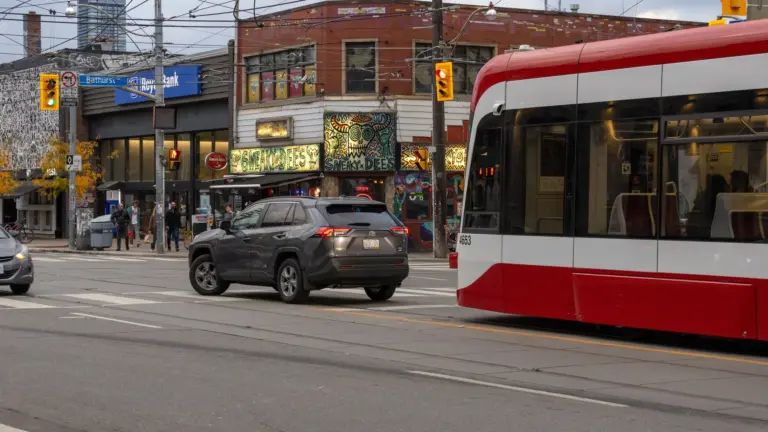

Toronto streetcars are slow because the city makes them wait. They wait behind cars, at red lights, for turning drivers, at closely spaced stops, at switches and behind another streetcar that has bunched ahead. The vehicle is not the main problem. The street and operating rules are.
Our verdict: full transit signal priority would create the fastest system-wide improvement. Dedicated lanes with real enforcement are the strongest corridor fix. Stop consolidation can help, but it should come after signals and traffic rules because longer walks hurt older and disabled riders. The most overrated idea is buying faster vehicles. A faster streetcar still sits at the same red light.
The TTC has started a serious improvement plan, including more signal work, operating-rule review, switch changes and stop-spacing study. That is welcome. It is also late.
The short answer
| Cause | How much it matters | Best fix |
|---|---|---|
| Red lights with weak priority | Very high | Give an approaching streetcar a green or extend the current green |
| Mixed traffic | Very high on downtown routes | Reserved lanes, turn restrictions and parking removal |
| Cars blocking lanes and intersections | High and unpredictable | Camera or officer enforcement, towing and clear loading space |
| Stops too close together | Moderate to high on some corridors | Merge selected stops with accessible replacements |
| Stops placed after traffic lights | Moderate | Move stops before the signal or coordinate the signal with boarding |
| Slow switch rules | Moderate at many junctions | Modern switches and revised safe operating rules |
| Long passenger boarding | Variable | Accessible platforms, all-door boarding and working fare equipment |
| Bunching and short turns | High during disruption | Active line management and recovery time |
| Construction | High but temporary | Better staging, priority through work zones and reliable replacement plans |
Toronto does not have one streetcar problem
The 512 St. Clair, 509 Harbourfront and much of 510 Spadina run in reserved space. They are not delayed in the same way as the 506 Carlton or 505 Dundas in mixed traffic.
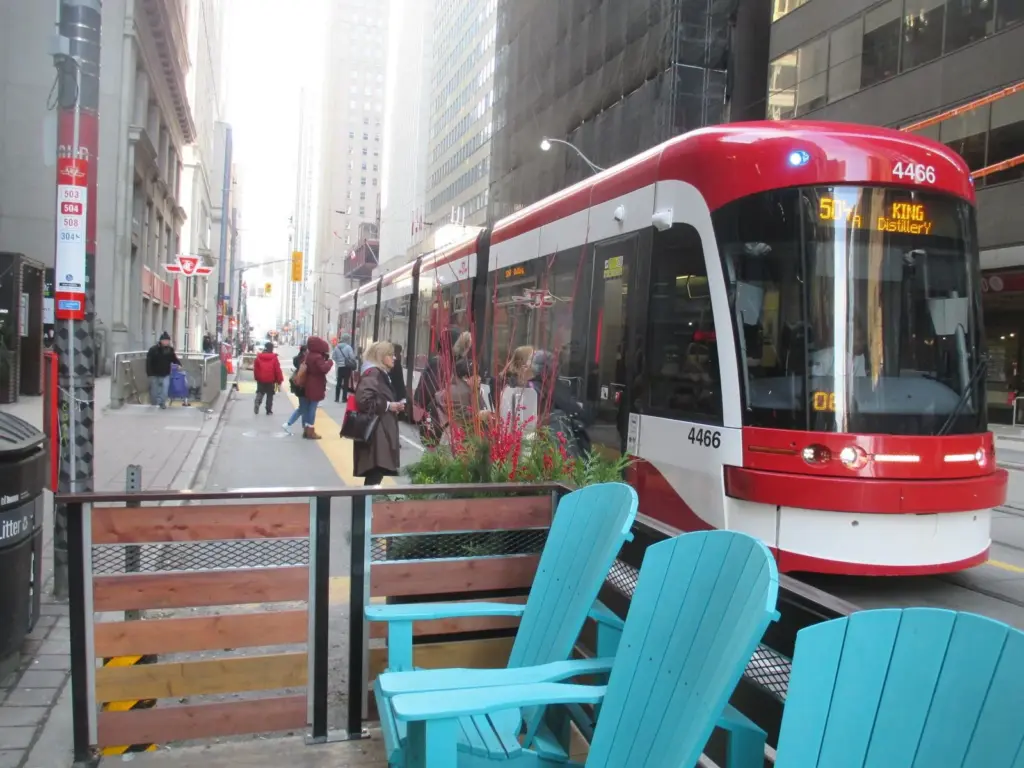
The 504 King benefits from transit-priority rules in the core, but turns, deliveries and gaps in priority still matter. The 501 Queen crosses a very long corridor where one incident can spread delay far away.
Any article that gives one average speed and treats every route as identical is too simple.

All 10 main Toronto streetcar corridors, honestly
| Route | Main problem | Our judgement |
|---|---|---|
| 501 Queen | Extreme length, mixed traffic, construction and bunching | Needs stronger lane and intersection priority across key sections |
| 503 Kingston Road | Shared Queen and King congestion, limited service pattern | Useful when it runs well, but too vulnerable to downtown delay |
| 504 King | Turning traffic, loading and incomplete enforcement | Best proof that street rules can help, but the project should be stronger |
| 505 Dundas | Mixed traffic, close stops and downtown intersections | One of the clearest signal-priority candidates |
| 506 Carlton | Mixed traffic, left turns, long route and stop spacing | Often painfully slow. Signals and line management matter more than branding |
| 508 Lake Shore | Long peak trip through several conditions | A fragile one-seat ride that needs protection at its downtown end |
| 509 Harbourfront | Reserved track but busy signals and event crowds | Better than mixed traffic, yet still slower than the right-of-way suggests |
| 510 Spadina | Reserved track with too many red lights and close stops | Toronto's strongest example of a lane that fails without signal priority |
| 511 Bathurst | Mixed and priority sections, turns and lane violations | Recent red lanes help, but gaps and enforcement weaken them |
| 512 St. Clair | Reserved track, intersections and many stops | Reliable by Toronto standards, but not as fast as a separated line should be |
Problem 1: streetcars do not get a useful green wave
Transit signal priority is often described as if it lets a streetcar run every red light. It does not need to work that way.
A signal can hold a green for a few more seconds when a packed streetcar approaches. It can shorten a side-street phase. It can give transit a short head start before turning traffic moves.
The TTC says enhanced priority changes have saved up to 42 per cent of delay at an individual intersection in some work. It projected 70 new or updated installations in 2026 and described a long-term network of about 800 intersections.
That is the right project. The embarrassing part is how many major streetcar intersections still make a vehicle carrying dozens of people wait so a few cars can turn.
Problem 2: a painted lane is not a protected lane
Red paint tells drivers the rule. It does not physically stop a driver from using the lane.
Delivery vehicles, taxis, ride-share pickups and impatient drivers can erase the advantage of a transit lane in minutes. One blocked streetcar can hold every vehicle behind it because a streetcar cannot steer around the problem.
Enforcement needs to be quick enough to matter. A ticket mailed weeks later may punish the driver, but it does not move the streetcar. Toronto needs camera evidence, towing for serious blockages and legal loading areas nearby.
The best reserved lane is one drivers cannot casually enter. Use curbs or raised separation where emergency access and intersections allow it.
Problem 3: left turns stop a whole streetcar
A single car waiting to turn left can block a streetcar with 70 people. That is a terrible exchange of public time.
Ban left turns at the worst intersections during service hours. Provide a different route for the driver. The turn may take a few minutes longer. The streetcar should not.
Right turns can also block transit when drivers wait for a gap in pedestrians. Separate signal phases or turn restrictions can help.
Problem 4: Toronto has too many closely spaced stops
Every stop adds braking, door time and acceleration. A long route with dozens of close stops loses minutes even when traffic is clear.
Some stops should be combined. But a city cannot simply delete every second stop and call the line fixed.
The replacement stop needs a safe crossing, level boarding where possible, shelter, seating and a manageable walking distance. Hills, hospitals, seniors' buildings and major destinations matter.
Do stop consolidation carefully. Do signal priority quickly.
Problem 5: many stops are on the wrong side of the light
Picture a streetcar waiting at red. The light turns green. The vehicle crosses the intersection, stops again to board passengers and misses the next green.
A far-side stop can work well when signals know the streetcar is coming and hold the phase. Without that coordination, it creates two waits.
Near-side stops have their own problems, including queues that block intersections. The point is not that every stop belongs on one side. The stop and signal must be designed together.
Problem 6: switch rules make streetcars crawl
Streetcars slow sharply at track switches. This protects against a switch being set the wrong way or moving under a vehicle.
The safety reason is real. The current delay does not have to be permanent. Modern switch detection, maintenance and clearer signals can allow safer, more confident movement.
The TTC has committed to switch modernization and an operating-rule review. Good. Riders should judge the result in travel time, not the number of reports completed.
Problem 7: bunching destroys the schedule
A slightly late streetcar meets more waiting passengers at every stop. Boarding takes longer. The car becomes later. The streetcar behind it finds fewer passengers and catches up.
Soon two or three vehicles arrive together, followed by a long gap.
The TTC needs active line management that separates vehicles before the gap becomes severe. That can mean holding one vehicle briefly, turning another short or adding recovery time at the end.
Short turns anger riders when they are unexplained. They can still be the least bad tool during a disruption. The TTC should state the destination clearly and protect the abandoned section with another vehicle.
Problem 8: Toronto uses streetcars like buses but gives them less freedom
A bus can move around a parked car. A streetcar cannot. That makes curb and lane discipline more important on a rail route.
Toronto often keeps ordinary car access, parking and loading on streets where the transit vehicle has no alternative path. Then it blames the route for being unreliable.
If the city chooses rail in mixed traffic, it must control the traffic.

Problem 9: construction plans treat transit as an afterthought
Track, utility and building work will happen. The quality of the detour is a choice.
A streetcar route should keep priority through a work zone when safe. Replacement buses need clear stops, enough vehicles and direct customer information. Construction should not remove a transit lane only to preserve curb parking.
Toronto is bad at explaining when a change ends. Every project page should show the current route, next change and expected restoration date in plain language.
Problem 10: the network is asked to do too much with too little recovery
Long cross-city routes are convenient when they work. They also spread delay. A blocked intersection in the west can hurt service in the east.
Splitting a route can improve reliability but create a transfer. There is no honest universal answer.
Our preference is to keep useful one-seat rides only when active management can hold regular service. If gaps remain severe, split the route at a strong, accessible transfer point and run both halves often.
What the TTC has promised for 2026 and after
The TTC Board approved work on enhanced transit signal priority, stop spacing, operating rules, switch operation, terminal congestion and raised stops. A College streetcar corridor study is expected in 2027, and priority work has been discussed for Spadina, Bathurst and Dundas.
These are the right categories. They will fail if the City refuses to remove car privileges at the exact intersections causing delay.
Transit improvement is not only a TTC job. Transportation Services controls signals, turns, parking and road design. Toronto cannot let two agencies point at each other while the streetcar waits.
The five fixes we would do first
1. Full signal priority on 510 Spadina
Spadina already has reserved track. Its slow trip makes the cost of weak signals obvious. Fixing it would prove the concept on a corridor everyone can see.
2. Left-turn bans on the worst 504, 505 and 506 intersections
One turning driver should not stop a full streetcar. Use clear signs and enforce them.
3. Camera enforcement for blocked lanes and open-door passing
Use evidence from transit vehicles to issue legal penalties once provincial and municipal authority is in place. Publish results.
4. A stop-spacing review with an accessibility test
Merge low-use stops only when the next stop has a safe crossing and usable boarding space. Add benches and raised platforms before removing access.
5. Real loading zones off the transit path
Businesses need deliveries. That does not require a truck to block the streetcar. Schedule loading and use side streets or designated bays.
What would not fix the problem
New streetcars alone will not. A new colour will not. Asking operators to drive harder will not. A public-awareness campaign without enforcement will not.
Removing every close stop without changing signals will produce a harsher walk and only part of the promised speed.
The city must make choices about road space. There is no technical trick that lets a streetcar move quickly through unlimited car traffic, turns and parking.
How riders can report a problem usefully
For a vehicle blocking tracks, give the route, direction, intersection, time and licence plate if you can record it safely. Do not step into traffic for a photo.
For repeated signal or turn delay, write to 311 and your councillor. Describe the pattern, not only one bad trip. A short video from a safe public location can show several cycles of the same problem.
For current service, use TTC alerts and a reliable arrival app. The posted schedule cannot predict a blocked intersection.
Keep exploring Toronto
- Why Uber delays happen in Toronto and what to use instead
- Toronto driving rules that visitors often miss
- The best walkable GO Train day trips
Official pages to check
Prices, rules, hours and project details can change. Check these primary pages before you spend money or make a special trip:
- TTC Board highlights, April 2026
- TTC CEO report, March 2026
- TTC Board highlights, July 2026
- TTC 2026 Annual Network Plan consultation summary
Frequently asked questions
Are Toronto streetcars actually slower than buses?
It depends on the corridor. A streetcar can carry many people and move well in reserved space, but mixed traffic and fixed rails make a blockage especially damaging.
Why do streetcars stop at so many red lights?
Toronto has incomplete transit signal priority. Some intersections offer limited help, while others follow ordinary traffic timing even when a streetcar is approaching.
Would removing streetcar stops make the route faster?
Yes, selected stop consolidation can save time. It should follow an accessibility review and come with safe crossings, seating and better boarding at the remaining stops.
Why do streetcars slow down at track switches?
Operators follow safety rules intended to confirm that the switch is set and stable. Modern equipment and revised safe rules can reduce the delay.
Do dedicated streetcar lanes work?
Yes, when drivers stay out, turns are controlled and signals give transit priority. A red lane without enforcement or signal changes delivers only part of the benefit.
Which Toronto streetcar route should be fixed first?
Start with 510 Spadina signal priority because the reserved track already exists and the delay is easy to see. For mixed traffic, 506 Carlton needs strong intersection and line-management work.
Who controls streetcar speed, the TTC or the City?
Both. The TTC controls vehicles, operators and service management. City Transportation Services controls many signals, turns, parking rules and street designs.