


Opening a coffee shop in Toronto can cost far more than the espresso machine and first month's rent. A tiny walk-up window in a space that needs new plumbing, electrical work and food-service approvals can use $20,000 before it is close to opening.
There is no honest single startup price. The useful number comes from written quotes for one address, one menu and one lease. A former café with working systems may cost much less than a former convenience store that needs a full conversion.
Our advice is firm. Do not sign a commercial lease because the space feels perfect. Price the entire business first, test the idea cheaply and keep enough cash for delays and slow months.
The quick answer
- Check zoning and licence requirements before signing a lease.
- Get the commercial lease reviewed by a lawyer who works with business tenants.
- Ask a designer or contractor to confirm plumbing, electrical, ventilation, washroom, accessibility and permit work.
- Get written equipment and installation quotes.
- Count rent deposit, additional rent, HST, insurance and utilities.
- Include wages for staff and a living wage for the owner.
- Build a month-by-month cash-flow plan, including winter.
- Calculate the number of transactions needed to break even.
- Test the menu at a permitted pop-up, market or shared counter before accepting a long lease.
If the plan depends on zero-interest personal credit cards, perfect weather and full sales from opening day, it is not ready.
Why nobody can give you one Toronto startup number

The address changes almost everything.
A ready-made café may already have sinks, drains, electrical capacity, a grease interceptor, counters, an accessible entrance and a suitable washroom. A plain retail unit may have none of them.
Two shops with the same floor area can have very different costs because one needs only paint and equipment while the other needs design work, permits and construction.
The menu changes the number too. Espresso and purchased pastries need less equipment than hot sandwiches, baking or cooking.
The only safe estimate is a site-specific budget supported by quotes.
The three budgets you need
Do not put every expense into one pile. Build three budgets.
1. Cost to reach opening day
This includes deposits, legal work, design, permits, construction, equipment, furniture, signs, initial inventory, insurance and setup.
2. Monthly operating cost
This includes rent, additional rent, wages, payroll costs, ingredients, cups, utilities, insurance, software, repairs, cleaning, accounting, debt payments and the owner's pay.
3. Working capital
Working capital is cash kept available for the period when sales do not yet cover costs. It pays for a delayed permit, broken grinder, slow winter week or supplier deposit.
Spending every dollar on the build leaves the business unable to survive its first surprise.
Full startup accounting example with every dollar shown
The example below is fictional. It is not a contractor quote, loan offer or claim about what every Toronto café costs.
It models a 650-square-foot takeaway shop in a former food-service unit. The space still needs a moderate renovation. It does not need a full restaurant kitchen or a new accessible washroom.
The purpose is to show how a complete budget works. Replace every number with a written quote for the actual address.
| Opening use of cash | Example amount | What it means in the accounts |
|---|---|---|
| Lease deposit and prepaid rent | $13,000 | An asset until the rent is used or the refundable deposit is returned. |
| Legal, incorporation and opening accounting | $4,000 | Some costs may be current expenses. Ask the accountant how each item is treated. |
| Design and engineering | $9,000 | Often connected to the leasehold project and may be capitalized. |
| Permits, licences and inspection fees | $3,500 | Treatment depends on the fee and the project it supports. |
| Leasehold improvements | $75,000 | A capital asset. It is not normally deducted as one giant expense in the opening month. |
| Espresso machine and grinders | $28,000 | Equipment recorded as a capital asset. |
| Refrigeration, dishwasher, filtration and brewer | $22,000 | Equipment recorded as capital assets. |
| Point-of-sale, security and internet installation | $4,500 | A mix of equipment, installation and current services. |
| Signage, counters, furniture and smallwares | $10,000 | Some items are capital assets. Low-cost items may be current expenses. |
| Opening inventory | $5,500 | An asset until the coffee, milk, food and packaging are sold or used. |
| Pre-opening payroll and training | $9,000 | A business expense. It is cash spent before customer sales begin. |
| Insurance and utility deposits | $3,500 | A mix of prepaid cost, refundable deposits and current expense. |
| Opening marketing | $3,000 | Usually a current business expense. |
| Three months of rent and TMI during construction | $18,900 | A carrying cost before the shop earns sales. |
| Construction and equipment contingency | $18,750 | Cash reserved for overruns. It is not an expense until it is spent. |
| Working capital after opening | $75,000 | Cash for losses, tax timing, payroll, repairs and slow months. It is not profit. |
| Total cash required before a safe opening | $302,650 | The total financing need in this example. |
These are cash-planning amounts. The example assumes HST is paid when a vendor charges it. An HST registrant may later recover eligible tax through input tax credits, but the business still needs enough cash to pay the invoice first.
The table also shows why “startup cost” and “opening-day expense” are not the same number. A $28,000 espresso system becomes an asset. A $75,000 cash reserve stays cash until the business spends it. A rent deposit may still belong to the business.
An accountant must decide the proper treatment, useful life and tax class for the real invoices. The Canada Revenue Agency explains the difference between current and capital expenses.
How the fictional shop tries to fund $302,650
| Source of money | Example amount | Important limit |
|---|---|---|
| Owner's cash | $60,000 | Equity is at risk and does not have to be repaid by the business. |
| Investor's cash | $40,000 | The investor will normally receive ownership or another negotiated right. |
| Five-year bank term loan | $120,000 | Creates monthly principal and interest payments. |
| Four-year equipment financing | $45,000 | The payment may continue even if sales are weak. |
| Landlord improvement allowance | $20,000 | It may be paid only after work is complete and documented. Read the lease. |
| Total identified funding | $285,000 | This is less than the cash requirement. |
| Unfunded gap | $17,650 | The shop should not open until this gap is removed or the plan is reduced. |
The owner cannot solve the $17,650 gap by pretending that working capital is optional. Removing $17,650 from the reserve would only move the shortage into the first slow month.
The example also excludes the owner's separate household emergency fund. Business working capital should not be the same money needed for rent, food or a family emergency at home.
Complete loan-payment example
Suppose the fictional bank loan is $120,000 at 8.25 per cent for 60 months. The monthly payment is about $2,447.55.
Suppose the equipment financing is $45,000 at 10 per cent for 48 months. The monthly payment is about $1,141.32.
| First-month debt calculation | Bank loan | Equipment financing | Total |
|---|---|---|---|
| Opening balance | $120,000.00 | $45,000.00 | $165,000.00 |
| Monthly payment | $2,447.55 | $1,141.32 | $3,588.87 |
| First-month interest | $825.00 | $375.00 | $1,200.00 |
| First-month principal | $1,622.55 | $766.32 | $2,388.87 |
The full $3,588.87 leaves the bank account. Only the $1,200 interest appears as an expense in the first month's profit-and-loss statement. The $2,388.87 principal reduces the loan balance.
This distinction is easy to miss. A café can report a small accounting profit and still lose cash after principal payments.
The rates above are assumptions, not current offers. A real loan may also include an application fee, guarantee, security, insurance, variable interest or a penalty for early repayment.
Start with the lease, not the logo
A commercial lease is not an apartment lease.
The posted rent may be only the base rent. A tenant may also pay property tax, maintenance, building insurance, utilities, garbage, snow clearing, common-area costs and HST.
These extra charges are sometimes called additional rent or TMI, meaning taxes, maintenance and insurance. Lease wording varies. The label matters less than the actual list of costs.
Ask for:
- base rent for every year of the term
- all additional-rent estimates and past reconciliations
- deposit and personal-guarantee terms
- permitted use of the unit
- rules for signs, deliveries and outdoor service
- who pays for plumbing, HVAC and electrical repairs
- renovation approval rules
- a rent-free construction period, if available
- renewal options and future rent formula
- assignment and subletting rights
- restoration duties when leaving
- a condition tied to permits, zoning, financing or inspection
Do not assume a tenant can simply cancel after two months. A right to exit must be negotiated and written clearly.
Commercial rent is not protected by the residential rent increase cap. Predictability must come from the lease.
Confirm the use before signing
The City says businesses should confirm zoning before leasing or buying a property.
An Eating or Drinking Establishment licence normally needs an approved Zoning Review for Business Licence. A business taking over a location with a valid licence, or one that expired less than three years ago in the same category, may not need that review.
Do not rely on a landlord saying, “A café should be fine.” Ask the City for the correct review and keep the written result.
A walk-up window also needs the right permitted use. The absence of indoor seats does not remove food, building or zoning rules.
A former convenience store may be an expensive conversion
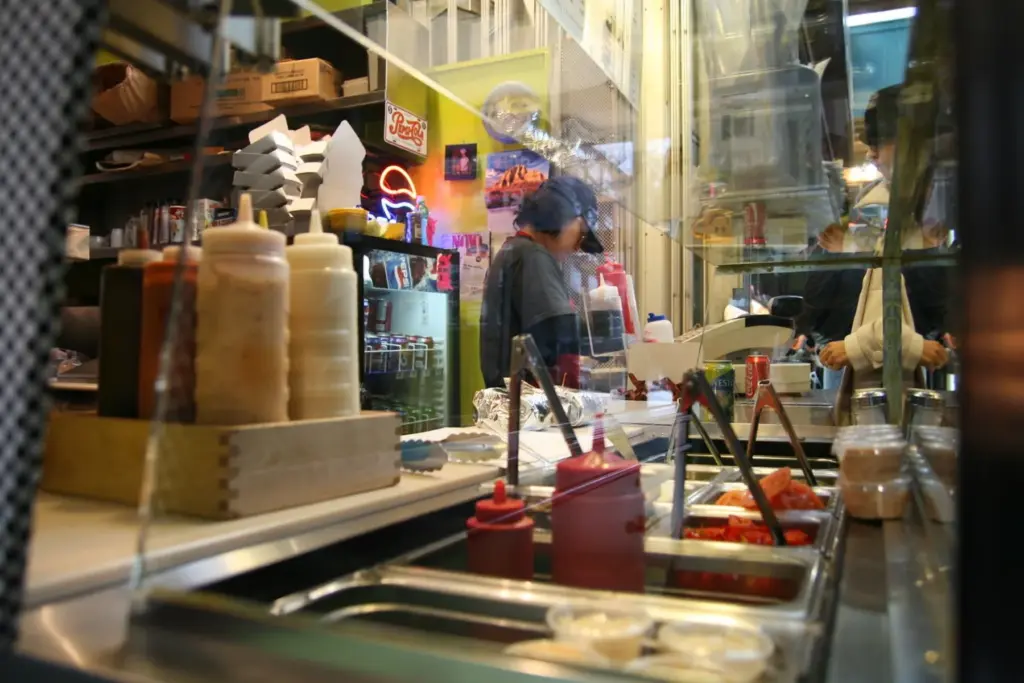
A convenience store and a coffee shop use water, drains, electricity and waste differently.
Check:
- handwashing and dishwashing sinks
- hot and cold water capacity
- floor drains where required
- grease interceptor requirements
- backflow protection
- electrical service for espresso equipment, grinders, refrigeration and water heating
- ventilation and heating at the service window
- food-safe walls, floors and counters
- pest-proof storage
- staff and public washroom requirements
- accessibility at the entrance and service point
- fire separation and occupancy limits
- garbage, recycling and organics storage
The City says installing or modifying plumbing may require a building permit. Material alterations and a change of use may also require permits.
Food-service businesses, including coffee shops, must install and maintain a grease interceptor on relevant plumbing under Toronto's Sewers By-law.
Get the requirements settled before pricing the renovation. A low verbal estimate is not a construction budget.
Permit fees are not the biggest permit cost
The City publishes building-permit fees. In 2026, its minimum building-permit fee is $214.79. Finished restaurant construction is listed at $30.94 per square metre, with separate fees for plumbing, HVAC and other work.
That does not mean a café conversion costs a few hundred dollars.
The application may need drawings, professional review, contractor labour and changes required after inspection. Rent can keep running during the wait.
The dangerous cost is often the full project and delay, not the fee line on the application.
Notify Toronto Public Health before opening
Every person planning to operate a Toronto food premises must notify the Medical Officer of Health before starting.
Toronto Public Health can review plans for a newly built or renovated food premises. The café must comply with Ontario's Food Premises Regulation and Toronto requirements.
The City says a food business must receive a DineSafe pass to operate. A current inspection notice is posted at the premises.
At least one certified food handler must be present during every hour in which food is prepared or served, subject to the current rule and business setup. Confirm the exact staffing requirement with Toronto Public Health before scheduling workers.
The licence list can grow with the concept
A basic café may need:
- business registration, if required for its legal name and structure
- an Eating or Drinking Establishment licence
- zoning approval
- building, plumbing, mechanical or sign permits when applicable
- Toronto Public Health notification and inspection
- food-handler certification
- HST registration when required
- workers' compensation and payroll accounts when applicable
- music licences if recorded or live music is used
Alcohol, entertainment, a sidewalk café, a food truck or a larger cooking operation adds another layer.
Use the City's licence finder and BizPaL for the actual concept. A checklist from another café may not fit.
Equipment is more than an espresso machine
The machine gets attention because it is visible. The support system costs money too.
Price:
- commercial espresso machine
- espresso and batch grinders
- brewer and hot-water equipment
- water filtration and treatment
- refrigeration and freezer space
- ice machine, if needed
- sinks and dishwasher
- scales, tampers, pitchers and smallwares
- point-of-sale hardware
- receipt printer and cash drawer
- shelving and food storage
- security system and cameras
- internet equipment
- cups, lids, napkins and bins
- spare parts and service plan
Ask whether the quote includes tax, delivery, installation, water treatment, training and warranty.
A used machine may save cash. It can also need repair, a new boiler, unavailable parts or a technician who will not certify it. Get the serial number and a technician's inspection before buying.
Buying and leasing equipment have different risks
Buying usually costs more cash at the start. Leasing can preserve cash but increase total cost and create a long payment.
BDC recommends comparing purchase price, down payment, lease-end cost, insurance, financing, training, delivery, installation, maintenance, repair and upgrades.
Ask what happens if the shop closes before the equipment lease ends. Ask whether the equipment can move to another location. Do not assume the machine is easy to resell at the price paid.
Staff cost more than the posted wage
Ontario's general minimum wage is $17.60 an hour through September 30, 2026. It rises to $17.95 on October 1, 2026.
The employer also has scheduling, vacation pay, statutory holiday, payroll contribution, training and coverage costs.
A small window still needs a plan for illness, breaks, opening, closing, deliveries and cleaning.
If the owner quits a full-time job, include the owner's living cost. A plan that calls owner labour “free” hides the largest sacrifice.
Do not build the budget around seven-day owner shifts forever. That is not a stable staffing plan.
Coffee is a volume business

A cup can have a healthy markup before overhead. The shop still has to pay rent and labour while nobody is ordering.
This is why transaction count matters more than the margin on one latte. The following monthly example uses the same fictional shop and financing assumptions shown above.
Complete monthly sales example, including HST
Assume the shop opens 30 days each month and completes 200 transactions a day. The average customer payment is $8.25, including Ontario HST.
| Sales calculation | Full number |
|---|---|
| Daily transactions | 200 |
| Days open | 30 |
| Monthly transactions | 6,000 |
| Average payment, including HST | $8.25 |
| Total cash collected from customers | $49,500.00 |
| Net sales before HST, calculated as $49,500 ÷ 1.13 | $43,805.31 |
| HST collected and owed before credits | $5,694.69 |
The $49,500 bank deposit is not the shop's sales income. The income statement records $43,805.31 as net sales. The $5,694.69 HST portion is money collected for the government.
Ontario's HST rate is 13 per cent for taxable sales. A business generally must register after it passes the federal small-supplier threshold. A business can also register voluntarily when eligible. The CRA explains when GST and HST registration becomes mandatory.
Suppose the books show $1,900 in eligible input tax credits for HST paid on rent, utilities, supplies and other commercial purchases during the month.
| Simplified HST account | Amount |
|---|---|
| HST collected from customers | $5,694.69 |
| Less eligible input tax credits | $1,900.00 |
| Estimated net HST to remit | $3,794.69 |
The $1,900 is an assumption, not a standard café credit. Some purchases may be zero-rated, exempt, partly eligible or subject to another rule. Keep every invoice and have a bookkeeper confirm the treatment. The CRA's input tax credit guide explains the basic rules.
Complete monthly cost of sales
The example assigns every sale a share of ingredients, packaging, payment fees and waste.
| Variable cost for 6,000 transactions | Monthly amount | Cost per transaction |
|---|---|---|
| Coffee, tea, milk, food and flavouring | $11,800.00 | $1.97 |
| Cups, lids, sleeves, napkins and takeaway packaging | $1,200.00 | $0.20 |
| Debit and credit-card processing | $1,050.00 | $0.18 |
| Waste, refunds and remakes | $550.00 | $0.09 |
| Total variable cost | $14,600.00 | $2.43 |
The average transaction produces $7.30 of sales before HST. After the $2.43 variable cost, it leaves about $4.87 to pay wages, rent, debt interest and every other fixed cost.
This $4.87 is the contribution per transaction. It is not profit.
Complete monthly payroll example
Assume hourly employees work a combined 520 hours in the month at an average wage of $18.50. Their gross wages are $9,620.
The owner-manager also receives a $4,500 gross salary. That amount is not the owner's take-home pay. Personal income-tax, CPP and other deductions depend on the payroll setup and the person's tax information.
| Payroll cost | Monthly amount |
|---|---|
| Hourly employee gross wages, 520 hours × $18.50 | $9,620.00 |
| Owner-manager gross salary | $4,500.00 |
| Four per cent vacation pay on hourly wages | $384.80 |
| Employer CPP and EI planning allowance | $980.00 |
| WSIB, training and coverage allowance | $194.60 |
| Total payroll cost to the business | $15,679.40 |
The $980 is a planning allowance, not a payroll remittance calculation. Exact CPP, EI and income-tax deductions depend on each employee, pay period and annual maximum. EI treatment can also differ for a controlling shareholder.
Use the CRA Payroll Deductions Online Calculator for the real payroll. Ontario employees with less than five years of service generally earn at least four per cent vacation pay under provincial employment standards.
Money withheld from an employee's gross pay is not an extra wage expense. The business records the gross wage as the expense, pays the employee the net amount and sends the withheld amount to the government with the employer's share.
Complete monthly profit-and-loss statement
This statement includes the owner's $4,500 gross salary. It also includes $1,200 of loan interest and $2,300 of depreciation and leasehold amortization.
| Fictional monthly income statement | Amount |
|---|---|
| Net sales before HST | $43,805.31 |
| Less coffee, food and other ingredients | ($11,800.00) |
| Less cups and packaging | ($1,200.00) |
| Less payment processing | ($1,050.00) |
| Less waste, refunds and remakes | ($550.00) |
| Gross contribution after variable costs | $29,205.31 |
| Hourly employee wages | ($9,620.00) |
| Owner-manager gross salary | ($4,500.00) |
| Vacation pay | ($384.80) |
| Employer CPP and EI allowance | ($980.00) |
| WSIB, training and coverage allowance | ($194.60) |
| Base rent | ($4,200.00) |
| TMI and additional rent | ($1,350.00) |
| Electricity, gas and water | ($900.00) |
| Business insurance | ($300.00) |
| Point-of-sale and other software | ($300.00) |
| Bookkeeping and accounting | ($300.00) |
| Cleaning, waste collection and pest control | ($500.00) |
| Repairs and regular maintenance | ($400.00) |
| Marketing | ($300.00) |
| Phone and internet | ($150.00) |
| Licence and certification allowance | ($100.00) |
| Office and other supplies | ($250.00) |
| Loan interest | ($1,200.00) |
| Depreciation and leasehold amortization | ($2,300.00) |
| Total fixed operating expenses | ($28,229.40) |
| Profit before business income tax | $975.91 |
The shop collected $49,500 from customers but produced only $975.91 of accounting profit before income tax. That is a margin of about 2.2 per cent on net sales.
The owner has received a $4,500 gross salary for working in the business. The $975.91 belongs to the business. It is not automatically another owner paycheque.
Removing the owner's salary would make the statement show $5,475.91 in profit. That would be misleading if the owner had to work full time to create those sales.
Profit is not the same as cash flow
Depreciation is an accounting expense but does not leave the bank account in that month. Loan principal leaves the bank account but is not an income-statement expense.
| Monthly cash-flow bridge | Amount |
|---|---|
| Accounting profit before income tax | $975.91 |
| Add back non-cash depreciation and amortization | $2,300.00 |
| Less estimated loan principal paid | ($2,388.87) |
| Cash left before tax, new equipment and owner dividends | $887.04 |
| Less voluntary equipment-replacement reserve | ($500.00) |
| Cash left after reserve | $387.04 |
This is why a shop can look profitable while its bank balance barely grows. A broken compressor or a $2,000 repair can erase several months of this cash.
Exact break-even calculation
Use this formula:
Break-even transactions = monthly fixed costs ÷ contribution per average transaction
For this example:
- Net average transaction before HST is $7.30.
- Variable cost per transaction is $2.43.
- Contribution per transaction is $4.87.
- Monthly fixed accounting expenses are $28,229.40.
- $28,229.40 divided by $4.87 equals about 5,800 monthly transactions.
- Over 30 days, accounting break-even is about 193 transactions a day.
Cash break-even is slightly higher because loan principal must be paid. Adding a $500 monthly equipment reserve raises the target to about 5,920 transactions, or roughly 197 transactions a day.
At an $8.25 tax-in average transaction, the shop needs close to 200 purchases every day merely to cover the full model. A rainy Tuesday and a holiday Monday still count.
Slow, expected and strong sales cases
| Monthly case | Slow | Expected | Strong |
|---|---|---|---|
| Transactions per day | 140 | 200 | 260 |
| Monthly transactions | 4,200 | 6,000 | 7,800 |
| Cash collected, including HST | $34,650.00 | $49,500.00 | $64,350.00 |
| Net sales before HST | $30,663.72 | $43,805.31 | $56,946.90 |
| Variable costs | ($10,220.00) | ($14,600.00) | ($18,980.00) |
| Fixed operating expenses | ($28,229.40) | ($28,229.40) | ($28,229.40) |
| Extra labour needed for strong volume | $0.00 | $0.00 | ($2,500.00) |
| Profit or loss before income tax | ($7,785.68) | $975.91 | $7,237.50 |
The slow case loses almost $7,800 in one month. Four similar months can use more than $31,000 of working capital.
The strong case needs extra labour. It would be dishonest to increase sales by 30 per cent while pretending the same team can always handle the work.
Full first-year example with seasonal losses
The next table keeps variable costs at one-third of net sales and fixed expenses at $28,229.40 a month. It is a planning model, not a promise about Toronto demand.
| Month | Net sales before HST | Variable costs | Fixed expenses | Monthly profit or loss | Cumulative profit or loss |
|---|---|---|---|---|---|
| January | $30,000.00 | ($10,000.00) | ($28,229.40) | ($8,229.40) | ($8,229.40) |
| February | $32,000.00 | ($10,666.67) | ($28,229.40) | ($6,896.07) | ($15,125.47) |
| March | $36,000.00 | ($12,000.00) | ($28,229.40) | ($4,229.40) | ($19,354.87) |
| April | $39,000.00 | ($13,000.00) | ($28,229.40) | ($2,229.40) | ($21,584.27) |
| May | $43,000.00 | ($14,333.33) | ($28,229.40) | $437.27 | ($21,147.00) |
| June | $46,000.00 | ($15,333.33) | ($28,229.40) | $2,437.27 | ($18,709.73) |
| July | $48,000.00 | ($16,000.00) | ($28,229.40) | $3,770.60 | ($14,939.13) |
| August | $47,000.00 | ($15,666.67) | ($28,229.40) | $3,103.93 | ($11,835.20) |
| September | $45,000.00 | ($15,000.00) | ($28,229.40) | $1,770.60 | ($10,064.60) |
| October | $47,000.00 | ($15,666.67) | ($28,229.40) | $3,103.93 | ($6,960.67) |
| November | $50,000.00 | ($16,666.67) | ($28,229.40) | $5,103.93 | ($1,856.73) |
| December | $55,000.00 | ($18,333.33) | ($28,229.40) | $8,437.27 | $6,580.53 |
| First-year total | $518,000.00 | ($172,666.67) | ($338,752.80) | $6,580.53 | $6,580.53 |
The year ends with a $6,580.53 accounting profit before income tax. The owner salary is already included in fixed expenses.
But the business reaches a cumulative accounting loss of $21,584.27 at the end of April. Bills arrive before the profitable months recover that loss. This is why a full-year profit does not remove the need for opening cash.
In this model, the first year's loan payments total about $43,066.40. About $29,853.17 is principal and roughly $13,213.23 is interest based on the assumed amortization schedules. The monthly statement uses a flat $1,200 interest allowance, so the final accountant's year-end interest number would differ slightly.
After adding back $27,600 in non-cash depreciation and subtracting about $29,853 in loan principal, the $6,580.53 accounting profit produces only about $4,327 of cash before income tax and new capital purchases. Setting aside $6,000 for future equipment would leave the business about $1,673 short for the year.
Change every number to the real lease, payroll schedule, supplier quote and sales test. Then run a slow case that you genuinely believe could happen.
Count customers, not bus-stop riders
A bus stop can create foot traffic. It does not create customers automatically.
Observe the site in 15-minute blocks:
- weekday morning rush
- midday
- afternoon
- evening
- Saturday
- Sunday
- rain
- cold weather
- school holidays
Count people who pass on the same side, people who can see the window and people who already carry a drink. Note where the queue can stand without blocking the sidewalk or transit stop.
Talk to local residents without promising an opening. Ask where they buy coffee, what time and what would make them switch.
A few apartments nearby may support regulars. They may also produce weak midday traffic if residents work elsewhere.
A walk-up window can work, but winter is a test
A small window saves seating space, washroom use and cleaning. It also gives the customer no shelter, table or reason to stay.
Some customers want coffee as fast as possible. Others pay a café premium because they want a warm seat, a meeting place or somewhere to read.
The concept must choose its customer.
For winter, ask:
- Can staff work comfortably near the open window?
- Where does a customer wait in snow or freezing rain?
- Can the menu be served fast enough to prevent a line?
- Does wind enter the workspace?
- Can the window and pipes operate in extreme cold?
- Does the morning volume cover the quiet hours?
Do not use summer foot traffic as the whole-year forecast.
Marketing cannot repair weak unit economics
A strong launch can bring a crowd once. It cannot make every sale profitable.
The product needs a reason to win after the opening post disappears. That may be speed, coffee quality, a useful location, a distinctive food item, warm service or a fair price.
“Great coffee” is not specific enough. Many competitors say the same thing.
Write the reason in one sentence. Then test whether real customers care.
Barista skill and owner skill are different
Making good espresso helps. Running a coffee business also needs forecasting, purchasing, scheduling, food safety, equipment maintenance, hiring, bookkeeping and lease management.
Experience from ten years ago may not reflect current costs, machines, payment systems or customer habits.
The best preparation is current work inside a busy café, especially in a role that sees ordering, waste, labour and daily sales.
A home espresso setup cannot reproduce the speed and cleaning demands of a commercial morning rush.
Test the idea before a long lease
A small test cannot prove a permanent shop will work. It can disprove a weak menu before the expensive commitment.
Possible tests include:
- a permitted market stall
- a short pop-up with an existing licensed food business
- a rented coffee counter inside another business
- office or event service where the venue permits it
- a mobile operation with the required licence and inspection
Do not assume a food truck is cheap. Vehicles, commissary needs, licensing, parking, fuel and repair can create another large budget.
The test should measure orders per hour, average transaction, repeat demand, service speed, waste and labour.
When $20,000 is not enough
$20,000 may fund research, deposits, professional advice or a modest test. It should not be treated as proof that a gut-job café can open.
The red flags become severe when the same plan includes:
- a space with no food-service infrastructure
- borrowed renovation money
- personal credit-card debt
- no separate household emergency fund
- a quit job before financing and permits are clear
- employees needed from day one
- no winter sales case
- no repair reserve
- no owner pay
Zero-interest credit ends. The later rate and balance-transfer fee must be part of the plan. Using personal revolving debt for permanent leasehold work can leave the owner with debt after the business closes.
How to protect a partner or family member
Support does not require sharing the financial risk.
Decide before any lease or loan:
- whether finances are separate
- whether one partner will lend money
- the maximum amount at risk
- whether unpaid work is expected
- who pays household bills during startup
- whether a personal guarantee affects shared assets
- what happens if more money is requested
- the stop-loss point for closing or changing the concept
Put a loan between partners in writing. Do not guarantee a commercial obligation you do not understand.
The business owner should hear the concerns and answer them with numbers. The partner should avoid using insults or a breakup threat as a substitute for financial boundaries.
A practical go or no-go test
Do not sign until every answer below is written.
- The City has confirmed the required use review and licences.
- The lease has been reviewed and all rent is known.
- Renovation quotes match approved plans.
- Equipment quotes include installation and service.
- The menu has a cost for every item.
- Labour includes the owner and coverage.
- The sales forecast comes from counted traffic or a real test.
- The winter case still pays its bills.
- Working capital remains after the build.
- Personal finances can survive without business income.
- The downside does not threaten housing or essential savings.
- The owner knows the point at which the plan stops.
If several answers are missing, the decision is “not yet.” That protects the dream from a rushed address.
Our take
A coffee shop is not doomed because Toronto is expensive. A rushed coffee shop can be doomed by one lease and one weak budget.
The biggest mistake is confusing a small space with a small risk. Plumbing, permits, commercial equipment, labour and winter cash flow do not disappear because the service area is a window.
We would test the coffee, count the customers and price the build before choosing the unit. If the numbers work after a pessimistic case, the idea may deserve a careful launch. If they only work in the dream case, walk away from the lease.
Frequently asked questions
How much money do I need to open a coffee shop in Toronto?
There is no reliable flat amount. The worked example in this guide needs $302,650, but it is a fictional planning model, not a Toronto price. The real answer depends on the lease, food-service infrastructure, renovation, equipment, menu and working capital.
Can I open a Toronto coffee shop with $20,000?
$20,000 may support a small test or part of a ready-made takeover. It is unlikely to cover a gut renovation, commercial equipment, deposits, permits and a cash reserve by itself. A full budget may show a much larger need.
What licence does a coffee shop need in Toronto?
A typical café may need an Eating or Drinking Establishment licence, zoning approval, Toronto Public Health notification and inspection, food-handler coverage, and building or sign permits when applicable. The exact list depends on the menu and site.
Do I need a building permit to add coffee-shop plumbing?
The City says installing or modifying plumbing can require a building permit. A material alteration or change of use may also need one. Confirm the plans with Toronto Building before construction.
How many coffees must a café sell to break even?
The worked example needs about 193 daily transactions for accounting break-even and about 197 a day after loan principal and an equipment reserve. Its average customer payment is $8.25 including HST. A real café must divide its own fixed costs by its own contribution per transaction.
Is a walk-up coffee window cheaper than a full café?
It can reduce seating, furniture and cleaning needs. It still needs legal use, food-safe systems, commercial equipment, staff protection and enough year-round traffic. Winter can make the sales pattern harder.
Should I buy or lease an espresso machine?
Buying can lower long-term cost but uses more cash. Leasing can protect cash at opening but may cost more and continue after the shop closes. Compare installation, service, warranty and exit terms.
What is the safest way to test a coffee-shop idea?
Use a legal, permitted pop-up, market, shared counter or mobile setup. Measure transactions, average sale, speed, waste and repeat demand. A test is most useful when it can prove the idea wrong before a long lease.